


Summary
The Rastriya Swatantra Party’s (RSP) thumping victory in the recent elections in Nepal is also a huge responsibility bestowed on it by Nepalis. There are several challenges facing the RSP which it needs to manage with utmost care to deliver on its promises.
Introduction: The Election Results
In the first election for the house of representatives (lower house) after the Gen Z movement of September 2025 in Nepal, the Rastriya Swatantra Party (RSP) achieved a thumping victory. In the 165 seats under the First-Past-The-Post (FPTP) system, it won 125 seats. Of the 110 seats under the Proportional Representation (PR) system, the RSP secured 57 seats with nearly 48 per cent of the total valid votes cast in its favour. Thus, with 182 seats out of the total 275 seats in the lower house, the RSP is short of a two-thirds majority by just two seats.
With such an enormous victory by the RSP, the established political parties have been decimated. The Nepali Congress (NC) won a total of 38 seats (18 seats under the FPTP and 20 seats under the PR), the Communist Party of Nepal (United Marxist-Leninist) [CPN(UML)] won 25 seats (nine seats under the FPTP and 16 under the PR) and the Nepali Communist Party (NCP) won 17 seats (eight seats under the FPTP and nine seats under the PR). The two other parties that were able to cross the three per cent threshold of the PR votes to become national parties and secure seats under the PR system were the Rastriya Prajatantra Party (RPP) and the Shram Sanskriti Party (SSP).
The RPP is a pro-monarchy and a pro-Hindu state party. It secured just a single seat under the FPTP system and four seats under the PR system. The SSP is a new party founded by Harka Sampang, an independently elected mayor of Dharan, a city in eastern Nepal, who resigned from his mayoral role and contested the election for the lower house. Harka and two SSP’s candidates secured three seats under the FPTP system, and the party received sufficient PR votes to secure four additional seats.
The other parties, particularly regional parties from the Madhesh, a province in the southern plains of Nepal, have been completely decimated. These parties had been instrumental in seeking the rights of the Madhesi (people from the Madhesh region) and in establishing federalism in Nepal,[1] but this time they could not secure their turf. Most of the older-generation leaders, including the most senior ones in their respective older parties barring Prachanda of the NCP, lost the election, and by huge margins. Nepal’s new lower house of parliament will have a super majority of new and young Members of Parliament, including around 20 from the Gen Z age group.
Reasons for the RSP’s Thumping Victory
The RSP was founded by Rabi Lamichhane, a popular television anchor, a few months before Nepal’s general elections in 2022.[2] It participated in the 2022 elections and secured 21 lower house seats in its first attempt. The RSP then managed to secure such a win by appealing to Nepalis against corruption, bad governance and a lack of domestic employment opportunities that had forced Nepali youths to migrate abroad. Rabi, while running his television show, had presented himself as a messiah.[3]
It was expected that the RSP would be an effective opposition force in parliament, but it joined the coalition governments under the premierships of the same old leaders, particularly K P Sharma Oli and Prachanda. Meanwhile, Rabi was disqualified from being a member of parliament by Nepal’s Supreme Court because he had not re-acquired his Nepali citizenship after returning to Nepal and renouncing his American citizenship.[4] However, in the by-election that he contested after re-acquiring Nepali citizenship, he won and secured even higher votes than in the previous election. Rabi was also embroiled in a case involving the possession and use of dual passports (the Supreme Court is yet to deliver a verdict in the case). Nevertheless, he was a political favourite of many people.
Rabi was behind bars on cooperative scam cases when the Gen Z uprising happened in Nepal. Amidst the arsons and destructions on 9 September 2025, some of his supporters set him free from prison although he claimed that he was temporarily freed by the prison authority for security reasons.[5] Rabi’s escape inspired a number of jailbreaks throughout the country the same day and thousands of inmates set themselves free posing security threats. Some leaders of the Gen Z movement opposed Rabi’s escape saying that their movement was not to free someone from prison.[6] They asked Rabi to return to jail. Rabi surrendered after a few days. This episode eroded Rabi’s and the RSP’s image considerably.
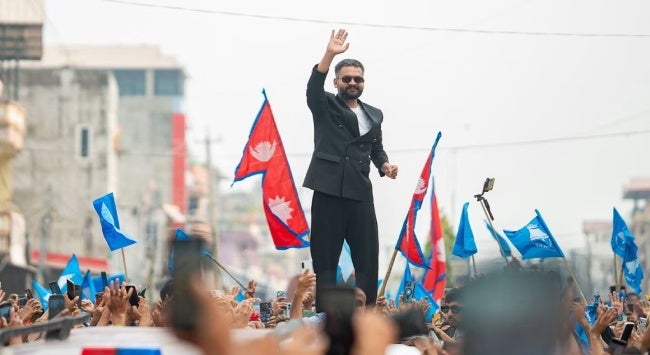
A few months before the 2026 election, Rabi was freed on bail by one of the appeals courts although the Supreme Court had earlier refused to let him free. Soon after he was out of jail, he got Balendra Shah, popularly known as Balen, the then sitting mayor of Kathmandu Metropolis, join the RSP as the party’s senior leader and the prime ministerial face in the upcoming election. This was the most important turning point for the RSP and a major factor in its massive victory in the recent election.
Balen had secured the mayor position in 2022 as an independent candidate. He made some positive changes in Kathmandu such as clearing up occupied public spaces, managing street- and underground-parking and strictly implementing the legally-mandated scholarship provisions in Kathmandu’s schools, among several other changes. However, an official evaluation of Nepal’s local governments’ performances based on several indicators has revealed that the Kathmandu metropolis ranked the least among all the six metropolises in the country.[7]
Balen is averse to traditional media and takes to social media for a one-way communication. He would cause stir at times with unimaginable threats such as torching the federal government’s central secretariat, Singhadurbar, as well as unruly posts.[8] Yet, Balen has a huge fan following, not only among the youths but people of all age groups. He is looked up to as the one who can deliver. His Madheshi identity gave the RSP an edge in the Madhesh region. The Madheshi people wanted to see a Madheshi as Nepal’s prime minister.
Balen contesting the election against Oli in the latter’s home turf made him appear as one with courage and that made him the people’s favourite choice. Oli declining responsibility for the youths’ killings during the Gen Z protest, clinging to his party chair position and purging younger leaders in the party, showing arrogance in his speech and actions had made him extremely unpopular. However, no one had expected that Balen would beat him by more than three times the votes.
Also, in several other constituencies, people voted for the RSP oblivious of the party’s name and the candidate, let alone the party’s agenda. The only thing they knew was to stamp the ‘bell’, the RSP’s election symbol, to make Balen the prime minister.
Oli’s party, the CPN(UML), was widely expected to perform very poorly in the election. On the other hand, the other oldest and largest party, the NC, was expected to fare better. When the then party chair, Sher Bahadur Deuba, declined to hold the regular party convention before the election, the party’s then general secretaries, Gagan Thapa and Bishwa Prakash Sharma, aided by a majority of the party cadres, convened the special general convention of the party that chose Gagan as the chair and introduced some reforms to address some of the grievances of the youths. Despite that, the RSP wave was so strong that even Gagan, a seasoned politician with years of hard work and meticulous preparations for governance and socio-economic reforms, lost the election. A majority of the electorate did not buy into his reform agenda. The pictures and videos of cash looted and burned in Deuba’s residence on 9 September 2025 was fresh in the minds of the people, and they did not buy into Gagan’s promises of punishing the culprits following due process. Several people who admired Rabi also abhorred Gagan for his role in persecuting Rabi in the cooperative scam case.
The RSP’s Contract with the Public
Now that the election fever is over, it is time to focus on delivering results. The huge mandate that the people have given to the RSP is also a huge responsibility for the party. Before the election, the RSP produced a 100-point manifesto, which it has called a ‘promise paper’.[9] It also produced a one-page document with five priorities, namely, good governance, economic growth, employment, connectivity and diaspora.[10] It has set some goals against each priority. The RSP has termed this document a contract with Nepalis, further stating that if it fails to honour the contract when given a clear mandate to govern, then the Nepali electorate can vote the RSP out of power in the next election.
The RSP’s pledges, as illustrated in the contract paper, include setting up a commission to investigate the property of high office bearers since 1990, achieving more than US$3,000 (S$4,050) in per capita income and a US$100 billion (S$135 billion) economy. It has also pledged to create 1.2 million new jobs to reduce outmigration, generate 15,000 megawatts of hydroelectricity, 30,000 kilometres of national highways and 10 signature projects of national importance. It has also pledged to provide online voting rights to Nepalis living abroad and ensure continuity of Nepali citizenship based on descent, among others.
Some of these pledges, such as on per capita income, size of the economy and new employment generation are difficult, if not impossible, to achieve, given Nepal’s constraints. There are also a number of other pledges in the more elaborate ‘promise paper’, achievement of which might be a tall order for the RSP.
Importantly, if the Middle East conflict does not end soon, Nepal will have to evacuate millions of its citizens working as migrant workers in the region. The Herculean task of evacuating them, loss of employment resulting in the reduction of remittances that has been a lifeline for Nepal’s economy and the lack of employment prospects at home for the returnees, besides the impact of the conflict on inflation and energy availability and affordability will be a significant challenge for the new government.
In addition, there are other issues that could pose a challenge to the RSP.
The RSP’s Potential Challenges
Balen’s social media posts during his stint as Kathmandu’s mayor showed his aversion towards the RSP and Rabi. His entry into the RSP as its senior leader right before the election is not based on a shared ideology or anything concrete, but with the shared goal of achieving victory in the election. During the election campaigns, Balen worked closely with his previous team members rather than with the RSP’s core members. Therefore, it remains to be seen whether Balen becomes a core member of the RSP or continues to function on his own. The possible clash of personalities between Balen and Rabi cannot also be ruled out. At the same time, it is important to see how the two view the legal battles that Rabi is caught in and whether they have a consensus on leaving it to the courts to decide or withdraw the cases.
When he was an independently elected mayor of Kathmandu, Balen was not beholden to any party. His actions were based largely on his personal choices. However, as a party member, he will not have that leeway. Whether he realises the differences of acting as an independent mayor and a prime minister representing a party will determine his course of actions. In case of feuds between Rabi and Balen and intra-party squabbles within the RSP, the RSP’s promise of delivering good governance and development will be hampered.
The incoming government has to review and implement the recommendations of the commission that was formed to investigate the killings, arsons and destructions of 8-9 September 2025. The interim government has accepted the report, but it might not have the time to implement it. Implementing the recommendations of this report is also a promise made by the RSP in its ‘promise paper’. Some people who had been calling for the arrest and punishment of Oli and other high-level officials for the killings of youths during the movement won in the recent election contesting as RSP candidates. This needs to be handled with utmost care or else there could be confrontations. The government should follow transparent and due process.
In addition, the government should also book people involved in arsons and destructions on 9 September 2025. It is said that several people involved in such activities also won the election as RSP candidates.[11] The government cannot brush this aside and focus only on the 8 September 2025 events.
Nepal’s incoming house of representatives will comprise largely of new and young faces lacking experience. A few RSP leaders have had the experience of being ministers in the earlier governments, but for very short durations. The new government will also primarily comprise people lacking the experience of running ministries and navigating Nepal’s entrenched bureaucracy.
Last, but not the least, the government will face the challenge of managing geopolitics. Nepal’s geographic location between the two giants – China and India – is both a boon and a bane. Balen, as the Kathmandu mayor, had publicly displayed his aversion towards these neighbours and the United States.[12] As the prime minister, hopefully, he demonstrates diplomatic skills and restrains himself from making unwarranted posts. Yet the challenge of subtly managing geopolitics remains.
There is a strong sense of anticipation for change among Nepalis. Whether and in what form it will emerge remains to be seen.
. . . . .
Dr Puspa Sharma is a Senior Research Fellow at the Institute of South Asian Studies (ISAS), an autonomous research institute in the National University of Singapore (NUS). He can be contacted at puspa.sh@nus.edu.sg. The author bears full responsibility for the facts cited and opinions expressed in this paper.
[1] Democracy Resource Centre, “Madhesh Province: From Movement to Implementation of Federalism”, Political Situation Update No. 6, February 2024, https://www.democracyresource.org/wp-content/uploads/2024/03/DRCN-PSU-6Madhesh-Province-From-Movements-to-Implementation-of-Federalism-English-Version-February-2024-1.pdf.
[2] https://en.wikipedia.org/wiki/Rastriya_Swatantra_Party.
[3] Peter Gill, “Why Nepal loves Rabi Lamichhane – and why some revile him”, The Record, 18 September 2019, https://www.recordnepal.com/why-nepal-loves-rabi-lamichhane-%E2%80%93-and-why-some-revile-him.
[4] Post Report, “Supreme Court annuls Rabi Lamichhane’s status as lawmaker”, The Kathmandu Post, 27 January 2023, https://kathmandupost.com/national/2023/01/27/supreme-court-annuals-rabi-lamichhane-s-status-as-lawmaker.
[5] Purushottam Poudel, “RSP chief denies fleeing jail, says he was freed by police”, The Kathmandu Post, 5 November 2025, https://kathmandupost.com/national/2025/11/05/rsp-chief-denies-fleeing-jail-says-he-was-freed-by-police.
[6] “Gen Z movement slams bid to give clean chit to Rabi Lamichhane”, Republica, 15 January 2026, https://myrepublica.nagariknetwork.com/news/gen-z-movement-slams-bid-to-give-clean-chit-to-rabi-lamichhane-60-77.html.
[7] “Kathmandu ranks lowest among six metropolises: Report”, People’s Review, 14 February 2026, https://mypeoplesreview.com/2026/02/14/kathmandu-ranks-lowest-among-six-metropolises-report/.
[8] Puspa Sharma, “Unrest and reckoning: Nepal’s political watershed,” ISAS Insight, No. 768 (17 September 2025), https://www.isas.nus.edu.sg/papers/unrest-and-reckoning-nepals-political-watershed/.
[9] Rastriya Swatantra Party, “Bacha Patra 2082”, (Kathmandu: Rastriya Swatantra Party), 2026, https://rspnepal.org/manifesto.
[10] “Rastriya Swatantra Party Unveils ‘Citizen Contract’ Highlighting Dual Citizenship Proposal Amidst Legal Hurdles”, Ratopati, 17 February 2026, https://english.ratopati.com/story/48925/that-phrase-in-the-rsp-constitution-is-it-an-attempt-to-reveal-dual-citizenship.
[11] Khabarhub, “RSP criticized for fielding candidate linked to parliament arson”, Khabarhub, 27 January 2026, https://english.khabarhub.com/2026/27/532787/.
[12] Sushim Mukul, “What will Balen Shah as PM mean to Nepal’s roti-beti ties with India?”, India Today, 10 March 2026, https://www.indiatoday.in/world/story/nepal-pm-balendra-shah-what-for-india-relations-china-influence-kathmandu-politics-explained-2879500-2026-03-10.
Pic Credit: X@nabilajamal
-
 More From :
-
 Tags :
-
 Download PDF