


Five Years after the Galwan Clashes:
Reassessing India’s Indian Ocean Strategy
Sandeep Bhardwaj
9 February 2026Summary
The Indian Parliamentary Committee on External Affairs recently concluded a year-long assessment of India’s Indian Ocean Strategy. The document, combined with insights from budget documents, reveals the change in India’s maritime posture since 2020.
The 2020 Sino-Indian clash in the Galwan Valley has not only transformed India’s security position on its Himalayan border but has also significantly shifted its maritime strategy. Three key changes are noticeable.
First, New Delhi’s threat perception of Chinese presence in the Indian Ocean region (IOR) has considerably intensified. It is apprehensive of China’s swelling naval capabilities and growing economic penetration into the littorals and is also becoming increasingly suspicious of its intent in the IOR. Second, India has responded by embracing internal rather than external balancing by accelerating its naval modernisation programme. Capital outlay for the Indian Navy jumped by 56 per cent in the year of the Galwan clash and has recently surpassed even the Air Force for the first time in many decades. Third, India is reinforcing its efforts to build security partnerships with the littorals, especially through cooperation on maritime surveillance and sharing security perspectives.
Some aspects of Indian maritime strategy have shown greater continuity. Its attention remains affixed to its immediate neighbourhood and the IOR island states. Its naval posture also continues to lean towards its west (Gulf) rather than Southeast Asia. India also remains reluctant to align its maritime strategy too closely with the United States(US) or the Quadrilateral Security Dialogue (Quad).
This paper draws primarily on budget documents and a recent report evaluating New Delhi’s Indian Ocean Strategy produced by the Indian Parliamentary Committee on External Affairs. The committee report is based on testimonies from the Ministry of External Affairs (MEA), the Ministry of Defence (MoD) and the Indian Navy. It is a rare, in-depth, cross-institutional assessment of the Indian government’s maritime strategy that is publicly available (India’s naval doctrine, updated in 2025, has not yet been released to the public).
China in Indian Threat Perception
A notable feature of the parliamentary committee report is the heightened threat perception of China’s presence in the Indian Ocean. The hardening of the Indian attitude is driven by three factors. First, there is anxiety that the balance of power in IOR, which has historically favoured India due to geography, may alter significantly. This concern has acquired greater salience now because of the recent expansion of China’s maritime capabilities, its growing naval presence in the IOR and its economic penetration in the littoral countries. The committee notes the urgent need to address escalating China threat because it has “the potential to shift the balance of power in the region, challenging India’s strategic autonomy and undermining its influence over key maritime chokepoints”. The overarching goal, according to the committee, should be to ensure that “the Indian Ocean remains India’s Ocean”.[1]
India is also concerned about the effect of Sino-Pakistan alliance on the regional balance of power. China is assisting Pakistan’s naval modernisation by providing frigates, submarines, aircraft and unmanned assets, as well as developing its Gwadar port. The committee report flags “the increasing Chinese influence over Pakistan’s naval assets”, which may prove to be a significant threat in the future.[2]
The second factor intensifying New Delhi’s threat perception is its deep mistrust of Beijing’s intentions, which permeates its assessment of all China’s activities in the Indian Ocean, such as research, anti-piracy operations and economic aid to the littorals. In an atypically candid statement to the committee, the MoD asserts that, “India regards the Belt and Road Initiative (BRI) and the String of Pearls strategy as attempts to reshape the strategic geography by diluting India’s maritime influence in the IOR and altering it in China’s favour.”[3]
Thirdly, the Indian establishment is increasingly adopting a zero-sum approach to assessing China’s gains in the IOR. Even China’s non-belligerent actions in the economic sphere are viewed as “detrimental to India’s economic growth”.[4] Such an attitude forestalls the possibility of cooperation and intensifies suspicion.
Many of the concerns discussed above have been circulating in the Indian establishment since China’s forays into the Indian Ocean in the late 2000s. However, the current discussions suggest a meaningful stiffening of the Indian attitude, which is likely a result of a five-year ‘freeze’ following the Galwan Valley clash, combined with China’s growing capabilities. This shift in attitude may prove to be lasting. Even the Sino-Indian ‘thaw’ may be unable to reverse this trend in the short term.
India’s Naval Buildup
The most evident impact of India’s heightened threat perception is the acceleration of its naval build-up in the Indian Ocean. In the years following the Galwan clash, some security experts expressed concerns that India’s excessive focus on the Himalayan border would come at the cost of its naval modernisation.[5] However, budget data demonstrates that, in fact, the clash prompted the government to invest more heavily in the development of the Indian Navy.
While India’s total defence capital outlay grew at an average annual rate of nine per cent between 2019-20 and 2024-25, the Indian Navy’s capital expenditure grew at 20.5 per cent. This is in stark contrast to the previous 10 years (2009-10 to 2018-19), when the Indian Navy’s capital expenditure grew at a slower pace (6.3 per cent per annum) than the overall defence capital expenditure (7.53 per cent per annum).[6]
The prioritisation of naval modernisation appears closely linked to the Himalayan border clash. The 2020-21 budget, announced in February 2020, allocated ₹26.7 billion (S$432.54 million) for the Indian Navy’s capital expenditure. Following the clash in June 2020, the Indian Navy’s capital expenditure for the year ended up climbing to ₹41.7 billion (S$675.54 million).
Significantly, the Indian Navy’s budget has not only increased in absolute terms but also as a proportion of total defence capital expenditure, as can be seen in Figurer 1. In 2022-23, the Indian Navy’s share surpassed that of the Air Force for the first time in decades.
Figure 1: Indian Navy’s share of defence capital expenditures
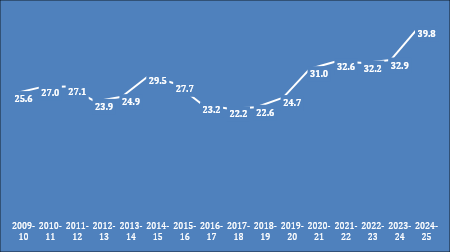
Source: Calculated from Budget Documents (2009-2025)
According to the Indian Navy’s submission to the committee, it currently has 137 ships and submarines, with 58 new units under construction to be inducted over the next six years. In addition, it aims to order 62 additional ships and submarines in the future. The goal is to overhaul the fleet with larger and more modern ships. By 2040, it envisages fleet ships with an average displacement of 6,000 tonnes (compared with 4,000 tonnes in 2014) and 80 per cent of units less than 15 years in age (compared with 47 per cent today).[7]
To be sure, India’s naval expansion plan remains relatively modest in ambition. Currently, the People’s Liberation Army Navy has over 370 ships and submarines and adds about 15 units a year. The China fleet is also newer than the Indian fleet.[8] However, given India’s geographic dominance over the Indian Ocean, it does not need to match China, warship for warship, to retain an edge in the regional balance of power.
Geography of India’s IOR Strategy
In the last few years, New Delhi has attempted to signal that its maritime interests extend beyond the Indian Ocean by launching the Indo-Pacific Oceans Initiative in 2019 and Vision Maritime and Humanitarian Assistance and Security and Growth for All in the Region (MAHASAGAR) in 2025. Reportedly, the 2025 Indian naval doctrine has done away with differentiating between geographical areas as areas of “primary” and “secondary” maritime interest. Nevertheless, it is apparent that New Delhi continues to reflexively stick to its traditional geographical outlook and priorities, except for two important changes.
As before, the immediate neighbourhood (Myanmar and Bangladesh) and island states (Sri Lanka and the Maldives, Mauritius, Seychelles, Comoros and Madagascar) remain the principal areas of concern in India’s maritime strategy, as made apparent by the committee report. This subregion receives the bulk of military and development assistance disbursed by New Delhi to the Indian Ocean littorals.
Furthermore, the Indian Navy’s outlook remains “weighted west” as before, that is, the Gulf continues to receive more attention than Southeast Asia.[9] Tellingly, the committee report makes practically no mention of Southeast Asia, while discussing the Indian Navy’s role in the Middle East at length. The Indian Navy has maintained a continuous presence in the Gulf of Aden since 2008 for anti-piracy operations. Since the beginning of the Israel-Hamas War in 2023, it has also stepped up its presence in the Persian Gulf and the Gulf of Oman under Operation Sankalp to protect merchant shipping. In contrast, the Indian Navy’s presence in Southeast Asia remains limited to exercises, ship visits and coordinated patrols.
This westward focus is driven by a combination of interests and constraints. The western Sea Lanes of Communication (SLOC) carry the majority of India’s trade, including trade with North America, Europe and all-important oil imports from the Middle East. Pakistan also keeps the Indian Navy west-facing, a trend that has been exacerbated by Operation Sindoor in 2025.
The Indian Navy is finding it more difficult to wade into Southeast Asia. The region is geopolitically saturated with the presence of several major powers, and there are no low-hanging fruit, such as anti-piracy operations. Some in New Delhi also worry that an assertive presence in the region may unnecessarily provoke Beijing, which considers Southeast Asia its backyard.
New Delhi’s geographical imagination has undergone two important shifts in recent years. Its conception of the immediate maritime neighbourhood has expanded to include the African island states of Madagascar and Comoros. Historically, these two states did not receive much attention in New Delhi (Comoros still does not have an Indian mission). However, since the late 2010s, India has intensified its diplomatic efforts to forge defence partnerships with them. The committee report makes it apparent that the Indian Navy now clubs these states along with Sri Lanka, the Maldives, Mauritius and Seychelles. The MEA has moved the two from its East and Southern Africa Division to its Indian Ocean Division. India’s interest in these two states likely stems from their location overlooking the chokepoint in the Mozambique Channel and the SLOC passing through the Cape of Good Hope.
India has also signalled deeper interest in East Africa in the last few years. It has established new forums to engage the region on security issues, such as the India-Africa Defence Dialogue and the India-Africa Army Chiefs’ Conclave. In 2022, India organised the first-ever maritime exercise with Tanzania and Mozambique, two littoral states of the Mozambique Channel. In 2025, India organised a larger multilateral exercise named Africa India Key Maritime Engagement, along with renaming a patrol vessel as the Indian Ocean Ship Security and Growth for All in the Region (SAGAR), crewed by a multinational group of naval officers drawn from various African countries.[10] Alongside its maritime security interests in the region, New Delhi is also hoping to penetrate Africa’s military equipment market to boost its defence export industry. However, as of now, Indian maritime engagement with Africa remains relatively shallow when compared to China, the US, France or the United Kingdom.
Security Partnerships
In recent years, India has evolved its rhetoric around its security role in the Indian Ocean, from calling itself “Net Security Provider” to espousing becoming “Preferred Security Partner and First Responder”. This reformulation lays emphasis on India’s efforts at maritime diplomacy. Although the accent on partnerships has the potential to expand India’s maritime role, the approach faces an inherent ceiling due to New Delhi’s reluctance to get entangled in alliances and the crowding-out effect from other great powers similarly canvassing for partners.
Maritime Domain Awareness (MDA) has emerged as a central theme in India’s security partnerships. The centrepiece of this effort is India’s coastal radar network, which operates in Mauritius, Seychelles, Sri Lanka and the Maldives. India has established the Information Fusion Centre in Gurugram and co-created the Quad’s Indo-Pacific MDA initiative. It also conducts joint Exclusive Economic Zone surveillance exercises with Seychelles, Mauritius and Mozambique and has provided hydrographic survey support to Myanmar, the Maldives, Mauritius, Seychelles, Mozambique, Sri Lanka, Tanzania and Kenya.[11]
Since the 1990s, the Indian Navy has maintained an ever-expanding portfolio of maritime diplomatic activities such as ship visits, Coordinated Patrols and bilateral and multilateral exercises. While these engagements are important instruments to signal India’s interests and project its power, they can have diminishing returns when most countries practise omnidirectional maritime diplomacy. It is commonplace for littorals to hold exercises regularly with several major powers. Moreover, India’s eschewal of formal alliances limits what joint exercises can achieve. Its security partnerships are also constrained by the fact that it is not a major exporter of maritime defence equipment in the Indian Ocean.
Many commentators have put great stock in India’s maritime partnerships with three great powers – Japan, Australia, and the US – under the aegis of the Quad. However, India remains lukewarm to the prospect of closer security cooperation under the Quad. As one MEA representative told the committee, “[T]he inclination of the other three partners to try and focus on security is somewhat tempered by the fact that we are the more reluctant partner when it comes to getting Quad to focus on security matters.”[12] Indeed, MDA cooperation is the only security-related Quad activity to elicit a strong Indian interest.
India appears more enthusiastic about the Indian Ocean Naval Symposium (IONS). Established in 2008 by the Indian Navy, IONS has 25 members and nine observers (including China). Notably, the US is the only major power not involved with the symposium. The MoD has indicated that it wants to ensure that the symposium is “not simply a talking shop” but a platform for cooperation on disaster relief, maritime security, and information-sharing. In particular, India aims to use the symposium to develop interoperability and a shared threat outlook for the IOR.
Conclusion
As the committee notes, India’s IOR strategy still requires “depth, clarity, and sustained resources”. It suffers from conceptual ambiguity (particularly the doctrinal overlap between SAGAR and MAHASAGAR); does not involve several key stakeholder ministries such as commerce, shipping, environment and home affairs; and has a piecemeal approach to security partnerships.[13] It also continues to adhere to traditional geographical habits such as a narrow focus on its immediate neighbourhood and the island states and a “weighted west” naval posture.
Nevertheless, it has undergone a substantial transformation since 2020. Growing China’s presence in the Indian Ocean, combined with the deterioration of overall China-India relations, has resulted in New Delhi’s heightened concern over the shifting balance of power in the IOR. Its response has been to substantially ramp up its naval modernisation and invest in wider security partnerships, especially to enhance MDA. It continues to be reticent to move closer to the US and other extra-regional powers in the Quad.
Indian naval power had been expanding over the last few decades as a natural outgrowth of its rising economy. However, it appears that New Delhi is now making a concerted effort to build up that power in the Indian Ocean to check what it perceives as a grave threat to its core interests. It remains to be seen whether the trend continues or whether shifting priorities or a lessening of Sino-Indian tensions slow it down in the future.
. . . . .
Dr Sandeep Bhardwaj is a Visiting Research Fellow at the Institute of South Asian Studies (ISAS), an autonomous research institute at the National University of Singapore (NUS). He can be contacted at sbhardwaj@nus.edu.sg. The author bears full responsibility for the facts cited and opinions expressed in this paper.
[1] Committee on External Affairs, Eighteenth Lok Sabha, “Evaluation: India’s Indian Ocean Strategy”, Eighth Report, August 2025, Lok Sabha Secretariat, New Delhi, 94-95.
[2] Ibid., 102.
[3] Ibid., 29.
[4] Ibid., 29.
[5] Arzan Tarapore, “Engaging with reality in the Indian Ocean”, United States Studies Centre, 12 September 2024, https://www.ussc.edu.au/engaging-with-reality-in-the-indian-ocean.
[6] Author’s calculations based on budget documents (2009-2025), except 2024-2025 figures, which are drawn from the Seventeenth Report of Standing Committee on Defence, Parliament of India, December 2025. All figures are actual expenditure, except 2024-25. Until 2015-16, naval capital expenditure did not include expenditure on the Joint Staff because budgets did not provide service-wise breakup. Capital expenditure includes expenditure on land, which is typically not included as part of modernization budget. However, the Indian Navy’s expenditure on land is usually miniscule and does not affect the overall trend. The 2025-26 Budget has not provided a service-wise breakdown of capital expenditure as of now.
[7] Committee on External Affairs, “Evaluation: India’s Indian Ocean Strategy”, op. cit. 46
[8] Interestingly, the average displacement of Chinese warships is comparable to India’s at 4,000 tons (completely outclassed by the US Navy’s average displacement of 12,000 tons), Alexander Palmer et al, “Unpacking China’s Naval Buildup”, Center for Strategic and International Studies, 5 June 2024, https://www.csis.org/analysis/unpacking-chinas-naval-buildup.
[9] Center for Naval Analyses, “Weighted West, Focused on the Indian Ocean and Cooperating across the Indo-Pacific: The Indian Navy’s New Maritime Strategy, Capabilities”, and Diplomacy, Research Report, (Arlington: Center for Naval Analyses, 2017) ), https://www.cna.org/archive/CNA_Files/pdf/drm-2016-u-013939-final2.pdf.
[10] Dinakar Peri, “India Navy announces maiden India-African exercise, Indian Ocean Ship (IOS) Sagar”, The Hindu, 24 March 2025, https://www.thehindu.com/news/national/india-navy-announces-maiden-india-african-exercise-indian-ocean-ship-ios-sagar/article69369880.ece.
[11] Dinakar Peri, “India looks at integrating more countries into coastal radar network”, The Hindu, 20 December 2020, https://www.thehindu.com/news/national/india-looks-at-integrating-more-countries-into-coastal-radar-network/article33379243.ece; Ajai Shukla, “India Launches Multinational Mission of Cooperation in Indian Ocean Region”, The Diplomat, 11 April 2025, https://thediplomat.com/2025/04/india-launches-multinational-mission-of-cooperation-in-indian-ocean-region/; and Department of the Prime Minister and Cabinet, “Indo-Pacific Partnership for Maritime Domain Awareness”, https://www.pmc.gov.au/resources/quad-leaders-summit-2023/indo-pacific-partnership-maritime-domain-awareness.
[12] Committee on External Affairs, “Evaluation: India’s Indian Ocean Strategy”, op. cit., 85-86.
[13] Ibid., 98.
Pic Credit: Wikimedia Commons
-
 More From :
-
 Tags :
-
 Download PDF