


Summary
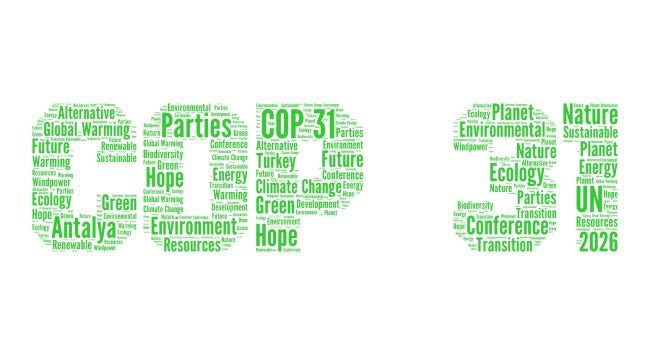
Another session of the Conference of the Parties to the United Nations Framework Convention on Climate Change (COP31) is taking place in Türkiye from 9 to 20 November 2026. Participating countries approach these conferences with high expectations; yet tangible progress on climate mitigation and adaptation remains limited. As in recent years, climate finance is likely to dominate the agenda. It is hoped that COP31 will deliver decisive steps towards advancing these goals.
The Conference of the Parties to the United Nations Framework Convention on Climate Change (COP31) officially opened in Türkiye on 9 November 2026. Once again, nations have travelled to Antalya with so much hope. Every such conference has been described as critical, every declaration as historic, and every agreement as a significant step towards saving the planet. Yet, temperatures continue to rise, glaciers retreat, forests disappear, oceans get warmer and extreme weather events become increasingly frequent and destructive. The question that will confront the participants is not whether the world understands the climate crisis; it is whether it possesses the collective political will to do something meaningful about it.
COP31 comes at a particularly important juncture. The Paris Agreement, signed in 2015, had raised hopes that the international community had finally found a framework to reconcile national interests with the collective responsibility of protecting the planet. Its ambition was to keep the rise in global temperatures well below 2°C, while pursuing efforts to limit it to 1.5°C above pre-industrial levels. A decade later, however, the distance between these aspirations and actual performance remains disconcertingly wide. Countries have announced targets, submitted climate action plans and made solemn commitments but the pace of implementation has been inadequate. The challenge before COP31 is not so much to discover new principles or negotiate declarations but to persuade countries to honour the commitments they have already made.
There are, of course, high expectations of what this conference will deliver. The transition to cleaner energy, the mobilisation of climate finance, adaptation to the impacts of global warming and support for countries facing irreversible climate-related losses are all likely to dominate the discussions. Each of these issues is important but they are also interconnected. A country cannot realistically be expected to abandon carbon-intensive energy overnight if affordable alternatives are not available; nor can a developing nation be asked to invest heavily in climate-resilient infrastructure if it lacks the financial resources to provide even basic amenities to its population.
The climate debate, therefore, is not simply about reducing emissions. It is equally about economic capacity, social justice and the right of nations to pursue development without being compelled to repeat the environmentally damaging trajectory followed by the industrialised world.
Climate Finance to be the Main Focus
The question of climate finance is likely to be one of the most contentious issues at Antalya. At COP29 in Baku, developed countries agreed to take the lead in mobilising at least US$300 billion (S$383.5 billion) annually for developing countries by 2035, within a broader ambition of scaling up climate finance to US$1.3 trillion (S$1.7 trillion) annually from all sources.[1] Much of the proposed financing was expected to come through multilateral institutions and private investment. However, private capital is guided primarily by commercial considerations. It is naturally attracted to projects offering predictable returns and is considerably less enthusiastic about financing flood protection, drought resilience or the rehabilitation of communities devastated by climate disasters. The countries that most urgently require assistance are often those least capable of attracting private investment.
This raises a fundamental question that has haunted climate negotiations for years: who should pay for addressing a crisis to which different countries have contributed so unequally? It is difficult to ignore the historical dimension of this debate. The developed world built much of its present prosperity through more than two centuries of industrialisation powered by coal, oil and gas. It accumulated wealth, technology and economic strength in the process, while generating a substantial share of the greenhouse gas emissions responsible for today’s crisis. Developing countries, meanwhile, are still struggling to provide electricity, housing, healthcare, education and employment to large sections of their populations. To expect both groups to shoulder identical responsibilities would be to overlook the very different circumstances in which they find themselves.
Move beyond Mitigation to Adaptation
The other important dimension of COP31 is the need to move beyond mitigation and pay greater attention to adaptation. For a considerable period, international climate discussions were dominated by the reduction of greenhouse gas emissions. While this remains indispensable, countries in the global south cannot afford to wait for global emission reductions to produce results before addressing the consequences of climate change already unfolding within their borders. Investments in climate-resilient agriculture, water conservation, coastal protection, flood management, urban drainage, early-warning systems and disaster preparedness are becoming increasingly urgent. The Global Goal on Adaptation, established under the Paris Agreement, is an important step in this direction. The challenge is to translate it into measurable progress and ensure that adaptation receives financial support comparable to that available for mitigation.
The issue of loss and damage is equally important. There are limits to how much a country can adapt to a changing climate. When rising sea levels threaten the very existence of island nations, when repeated floods destroy homes and livelihoods, or when prolonged droughts render agricultural land unproductive, the damage cannot always be repaired through conventional development assistance. The establishment of the Loss and Damage Fund at COP27 was, therefore, a significant recognition of the plight of vulnerable countries. However, a fund without adequate and predictable contributions risks becoming little more than a symbolic gesture. COP31 must address the difficult questions of how much money will be made available, who will contribute, how quickly assistance can be accessed and whether the resources will reach the communities that need them most.
One should also not underestimate the difficulties surrounding the global transition away from fossil fuels. At COP28 in Dubai, countries agreed to transition away from fossil fuels in energy systems in a just, orderly and equitable manner. While this was widely regarded as an important breakthrough, translating the declaration into concrete action has proved considerably more difficult. The interests of countries are simply too divergent. Some economies remain heavily dependent on coal, others derive substantial revenues from oil and gas, while many developing nations are still building the infrastructure required to provide reliable energy to their populations. Even within developed countries, the transition is complicated by political pressures, industrial interests and concerns about energy prices. The debate is, therefore, likely to continue at COP31, with countries differing over the pace of transition, the role of natural gas, the place of carbon capture technologies and the extent to which national circumstances should determine the energy pathway.
India will understandably resist any attempt to impose a uniform timetable for abandoning fossil fuels. Its argument is that the energy transition must be guided by national circumstances and the principle of equity. This is a legitimate position, but it also places a responsibility on India to demonstrate that it is pursuing a credible and progressive pathway towards cleaner energy. Climate leadership cannot rest indefinitely on the argument that others polluted more in the past. India’s growing economic influence and its expanding technological capabilities bring with them expectations of greater contribution to global solutions. The challenge is to meet these expectations without compromising the country’s legitimate developmental priorities.
Challenges over Competitiveness and Supply Chains
There is, moreover, a larger danger that climate negotiations may increasingly become entangled in geopolitical and commercial rivalries. The transition to a green economy is creating new opportunities for industrial competitiveness, control over critical minerals, battery technologies, renewable energy manufacturing and supply chains. Countries are beginning to view climate policy not merely as an environmental responsibility but also as an instrument of economic and strategic advantage. Carbon border adjustment measures and other trade-related environmental restrictions could impose additional costs on developing-country exporters. There is a genuine concern that environmental standards may sometimes become instruments of protectionism, particularly when developing countries lack the financial and technological capacity to comply with them. Countries such as India are cognisant of this possibility and have to ensure that the global climate framework does not inadvertently create new barriers to economic development.
Perhaps the greatest source of disappointment at COP31 could be the continuing gap between what countries promise and what they deliver. These annual conferences have become remarkably adept at producing carefully negotiated language. Every contentious issue is examined, debated and eventually reduced to a formulation acceptable to most participants. The final declarations often contain encouraging references to ambition, cooperation, solidarity and urgency. Yet the difficult questions of funding, accountability and implementation are frequently deferred. There is a danger that the process itself may become an end in itself, with the successful conclusion of a conference being mistaken for meaningful progress on the ground.
Geopolitical Challenges
The geopolitical environment adds another layer of uncertainty. International cooperation is becoming increasingly difficult at a time when countries are preoccupied with domestic economic pressures, trade disputes, security concerns and political instability. Climate change, despite its universal consequences, does not always command the same political priority as immediate national concerns. Governments may announce ambitious long-term targets, but their commitment can weaken when confronted with rising energy prices, unemployment or electoral pressures. The limited progress made in the preparatory climate negotiations during 2026 offers little reason for excessive optimism. Antalya will, therefore, have to contend not merely with technical disagreements but also with a broader crisis of confidence in multilateral cooperation.
Ultimately, the success of COP31 should not be judged by the number of declarations adopted or the eloquence of the speeches delivered. It should be judged by whether the conference helps narrow the distance between ambition and implementation, whether financial commitments become accessible resources, whether vulnerable communities receive meaningful support and whether countries begin to translate their climate promises into tangible domestic action. The world does not need another reminder that the planet is in danger. It needs a demonstration that governments are prepared to act collectively, even when doing so requires difficult political and economic choices.
India’s Position
COP31 offers India an opportunity to play a more constructive and influential role in shaping the international climate agenda. Its traditional position as the voice of developing countries remains important but it should not be confined to resisting proposals perceived to be inequitable. India has the economic scale, scientific capabilities and diplomatic influence to act as a bridge between the developed and developing worlds. It can demonstrate that a developing economy can expand renewable energy, improve energy efficiency, promote sustainable agriculture and build climate-resilient infrastructure while continuing to pursue economic growth. It can also work with other developing nations to ensure that climate finance, technology transfer and adaptation remain central to the international agenda. Such leadership would strengthen India’s credibility and give greater weight to its demand for climate justice.
India’s position at COP31 is likely to be firmly anchored on the principle of common but differentiated responsibilities and respective capabilities. It has consistently argued that climate action must be equitable and that the historical responsibility of developed countries cannot simply be wished away. India has made considerable investments in renewable energy and has emerged as an important participant in the global effort to develop cleaner technologies. However, it has represented the view of the global south in objecting to the expectation that developing countries should undertake disproportionately demanding obligations without receiving the financial and technological assistance necessary to fulfil them. In India’s view, the developed world must demonstrate leadership not merely through ambitious emission-reduction targets but also through predictable climate finance, affordable technology transfers and capacity building.
There is considerable merit in this argument, particularly when viewed against India’s developmental circumstances. With a large population, rising urbanisation and an economy that continues to expand, India’s demand for energy will remain substantial for several decades. Electricity is essential not merely for industrial growth but also for irrigation, transportation, digital connectivity, healthcare and improving the quality of life of millions of people. Coal continues to play a significant role in meeting this demand, and it would be unrealistic to expect India to abandon it without ensuring that affordable and reliable alternatives are available. The country’s energy transition must necessarily be calibrated to its economic realities. A transition that compromises energy security, raises the cost of electricity or threatens the livelihoods of millions would neither be sustainable nor politically feasible.
India has demonstrated that economic development and environmental responsibility can go hand in hand. Its expansion of solar and wind energy, promotion of energy efficiency, investments in electric mobility and growing interest in green hydrogen reflect a serious effort to diversify its energy sources. The International Solar Alliance, launched jointly by India and France, has also given the country an important platform for promoting solar cooperation among developing nations. India’s commitment to achieving net-zero emissions by 2070 and its target of obtaining 50 per cent of cumulative installed electric power capacity from non-fossil fuel-based resources by 2030 are significant milestones.[2] The country has also committed to reducing the emissions intensity of its GDP by 45 per cent from 2005 levels by 2030.[3]
India faces the challenge to reconcile two equally compelling imperatives: the right to development and the responsibility to protect the environment. These objectives need not be contradictory. But achieving them will require international cooperation based on fairness, accessible technology, adequate finance and respect for the differing circumstances of nations. The developed world must recognise that its historical contribution to the problem carries corresponding responsibilities. Developing countries, in turn, must demonstrate that prosperity need not follow the carbon-intensive trajectory of earlier industrialisation.
Conclusion
COP31 may well produce another carefully negotiated compromise, one that allows governments to return home claiming a measure of success. However, the real verdict will emerge long after the delegates have departed Antalya. It will be reflected in the quality of the air we breathe, the security of our water supplies, the resilience of our farms and cities, and the prospects of generations that will inherit the consequences of decisions taken today. The atmosphere has little patience for diplomatic postponements. It does not distinguish between developed and developing countries, nor does it recognise negotiating blocs or political reservations. It responds only to the cumulative consequences of what humanity does or fails to do.
The world has reached a point where climate diplomacy must deliver more than the promise of a better tomorrow. It must begin to secure that tomorrow through action today.
. . . . .
Mr Vinod Rai is an Honorary Senior Fellow at the Institute of South Asian Studies (ISAS), an autonomous research institute at the National University of Singapore (NUS). He is also a former Comptroller and Auditor General of India. He can be contacted at raivinod@hotmail.com. The author bears full responsibility for the facts cited and opinions expressed in this paper.
[1] “Countries agree $300 billion by 2035 for new climate finance goal – what next?”, United Nations Trade and Development, 10 December2024, https://unctad.org/news/countries-agree-300-billion-2035-new-climate-finance-goal-what-next.
[2] Yagyavalk Bhatt and Puneet Kamboj, “India’s Updated NDC: A Pathway to Net-Zero by 2070?”, Instant Insight, King Abdullah Petroleum Studies and Research Center, 9 October 2022, https://www.kapsarc.org/media/xnjnee3i/india%CA%BCs-updated-ndc-a-pathway-to-net-zero-by-2070.pdf.
[3] Debarshi Dasgupta, “Experts question India’s new climate change goals”, Asian Insider, The Straits Times, 13 August 2022, https://www.straitstimes.com/asia/south-asia/experts-question-indias-new-climate-change-goals-asian-insider.
Pic Credit: Shutterstock
-
 More From :
-
 Tags :
-
 Download PDF