


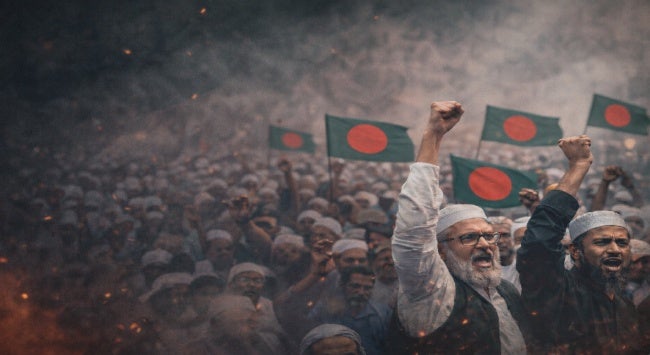
Bangladesh’s Post-Uprising Political Order:
Resurgence of Jamaat-e-Islami
Imran Ahmed, Mriganika Singh Tanwar
10 February 2026Summary
Jamaat-e-Islami’s resurgence reflects the broader transformation of Bangladesh’s political landscape following the upheavals of the country’s recent past. Rather than a simple ideological revival, the party’s re-emergence is rooted in organisational endurance, shifting alliances and the fragmentation of established patterns of political competition.
The re-emergence of Bangladesh Jamaat-e-Islami in the current political moment reflects a deeper transformation of the country’s party system rather than a simple revival of an older Islamist force. After years of marginalisation, legal constraints and political isolation, the party is reasserting itself as an organisationally coherent and strategically adaptive actor within a newly unsettled political landscape. Its resurgence is perhaps less about ideological reinvention and more about the structural openings created by Bangladesh’s post-2024 political transition.
Jamaat’s revival is rooted first in organisational endurance. Unlike many newer political formations such as the National Citizen’s Party that emerged from protest movements, Jamaat retained an extensive grassroots network, disciplined party structure and longstanding welfare and mobilisation channels even during periods when its formal political role was constrained. This organisational continuity has allowed the party to re-enter electoral politics more quickly than other actors and position itself as a political vehicle at a time when the system is undergoing reconfiguration.
Second, Jamaat has adopted a strategy of calibrated repositioning rather than overt ideological transformation. The party has framed itself less as a movement seeking to impose a doctrinal agenda and more as a participant in national political restructuring. By emphasising reform, governance and institutional participation, it has sought to expand its appeal beyond traditional supporters while avoiding the perception of radical rupture. This approach has enabled it to participate in alliances and negotiations that would have been politically difficult in earlier periods.
Third, Jamaat’s resurgence reflects the reordering of political competition following the collapse of established patterns of party dominance. The fragmentation of the political field and the entry of new actors have altered electoral incentives. In such an environment, a party with organisational discipline and ideological clarity gains strategic advantage. Jamaat’s ability to operate both independently and within alliances has allowed it to occupy political space that might otherwise have been dispersed among smaller or less structured groups.
The party has also benefited from a shifting social climate. Public debates over identity, morality and social order have become more visible and Jamaat’s messaging has aligned with constituencies receptive to conservative social framing. This does not necessarily indicate a wholesale ideological shift within Bangladeshi society, but it does suggest a widening of the discursive space in which the party can operate without the same level of marginalisation it previously faced.
At the same time, Jamaat’s resurgence is not without internal and external constraints. Its historical legacy continues to shape perceptions among sections of the electorate, particularly minorities and secular constituencies. The party’s organisational discipline is a strength but it also limits its ability to fully reposition itself ideologically. Balancing continuity with adaptation remains a central challenge: if it moves too far from its ideological base, it risks alienating core supporters; and if it moves too little, it struggles to broaden its appeal.
The emergence of younger political actors has also created both opportunity and tension. Jamaat’s engagement with youth-led movements and newer parties reflects a pragmatic recognition that generational change is reshaping the political arena. However, these relationships remain transactional rather than fully integrated, and ideological differences persist, particularly around questions of gender representation, political pluralism and the role of religion in public life.
Institutionally, Jamaat’s return signals an important shift. The party is no longer operating solely as an oppositional force but as a participant in shaping political arrangements and alliances. Its willingness to engage with reform debates and institutional processes suggests a strategic attempt to transition from a marginalised actor to a system-shaping one. This does not necessarily indicate a transformation of its ideological commitments; rather, it reflects a recalibration of political strategy in response to changing opportunities.
What makes Jamaat’s resurgence particularly significant is that it is occurring at a moment when Bangladesh’s party system itself is unsettled. Established political binaries have weakened (particularly with the ban on the Awami League’s activities), new actors are entering the field and the boundaries of participation are being renegotiated. In such conditions, parties that combine organisational depth with strategic flexibility are best positioned to gain influence. Jamaat appears to fit this profile.
Yet the durability of this resurgence remains uncertain. Much depends on whether the party can translate structural opportunity into sustained electoral relevance set to take place on 12 February 2026. Its future trajectory will hinge on its ability to maintain alliances, manage ideological tensions and respond to shifting public expectations. The same fluid political environment that has enabled its return could also constrain its long-term consolidation. Jamaat’s revival, therefore, likely tells us less about the party itself than about the transformation of Bangladesh’s political order. It reflects a system in flux, where institutional authority, party competition and political identities are being renegotiated simultaneously. The party’s re-emergence is both a product of this transition and a contributor to it.
Ultimately, Jamaat is not returning because it has fundamentally changed. It is returning because the political terrain around it has shifted. Its resurgence is a signal that Bangladesh’s party system is entering a new phase, one in which older actors are reappearing, new alliances are forming and the structure of political competition is itself being reshaped.
. . . . .
Dr Imran Ahmed is a Research Fellow at the Institute of South Asian Studies (ISAS), an autonomous research institute at the National University of Singapore (NUS). He can be contacted at iahmed@nus.edu.sg. Ms Mriganika Singh Tanwar is a Research Analyst at the same institute. She can be contacted at m.tanwar@nus.edu.sg.The authors bear full responsibility for the facts cited and opinions expressed in this paper.
Pic Credit: Chatgpt
-
 More From :
-
 Tags :
-
 Download PDF