


‘Bangladesh First’ under Tarique Rahman:
The Limits of Foreign Policy Diversification?
Imran Ahmed
3 September 2026Summary
Since taking office in February 2026, Prime Minister Tarique Rahman has moved quickly to widen Bangladesh’s external relationships. Although the depth and purpose of these relationships differ considerably, the broader pattern points less towards a new geopolitical alignment than towards an attempt to diversify Bangladesh’s foreign relations. However, this process contains an important contradiction: the pursuit of greater strategic autonomy through diversification could ultimately produce new commitments that constrain the very flexibility it is intended to create.
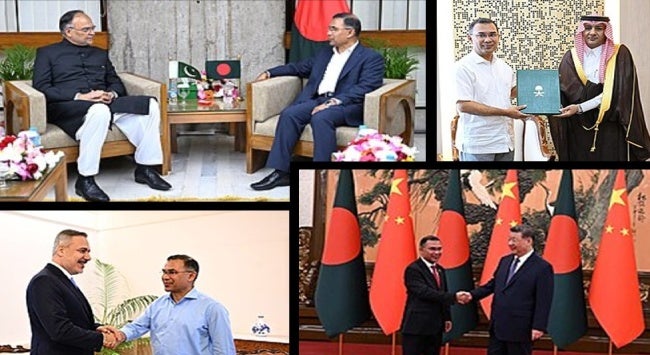
Since assuming office in February 2026, Prime Minister Tarique Rahman has moved swiftly to broaden Bangladesh’s international engagement. Relations with China have deepened, engagement with Pakistan has increased and Dhaka has sought closer economic and strategic ties with Saudi Arabia and Türkiye. Relations with India, however, remain difficult. Rahman’s proposed visit to New Delhi has yet to be finalised while Bangladesh continues to press India over the extradition of former prime minister Sheikh Hasina. Although the depth and purpose of these relationships differ considerably, the broader pattern points less towards a new geopolitical alignment than towards an attempt to diversify Bangladesh’s foreign relations.
China has been the most visible part of this process. Tarique Rahman visited China in June 2026, during which the two countries agreed to expand cooperation in trade, investment, infrastructure, connectivity and other areas. The relationship has continued to develop since the visit. In late August 2026, Bangladesh and China announced preparations for new diplomatic and defence dialogues. However, closer relations with Beijing have not been accompanied by an exclusive turn towards China. Tarique Rahman’s first overseas tour also included Malaysia, where Bangladesh pursued cooperation across a range of economic and strategic areas. This suggests that engagement with China forms part of a wider effort to expand Bangladesh’s diplomatic options rather than replace dependence on India with dependence on China.
The same pattern can be seen in Bangladesh’s growing engagement with Saudi Arabia and Türkiye. In August 2026, Tarique Rahman proposed transforming relations with Saudi Arabia into a “strategic, multidimensional and long-term partnership” that encompassed political, economic, security and people-to-people cooperation. Saudi Crown Prince Mohammed bin Salman subsequently invited Tarique Rahman to visit the kingdom. Relations with Türkiye are also becoming more institutionalised. Turkish Foreign Minister Hakan Fidan visited Dhaka in June 2026, where he met Foreign Minister Khalilur Rahman and Tarique Rahman. The two governments discussed expanding trade as well as cooperation in the defence industry.
Bangladesh’s interest in the Makkah Joint Defence Agreement could, however, test the limits of this approach. Signed by Saudi Arabia, Pakistan and Türkiye in August 2026, the agreement establishes a collective defence principle under which an armed attack against one member would be regarded as an attack against all. Bangladesh has publicly indicated that participation is being viewed positively. If Bangladesh were to join such an arrangement, it would be qualitatively different from simply strengthening bilateral relations with its three members. It could move Dhaka from flexible cooperation towards a more formal security commitment and make it harder to avoid questions about its position in wider regional rivalries. At the moment, the precise obligations of the agreement remain unclear. However, the pact has already begun to develop an institutional structure with its members establishing a Strategic Political and Defence Committee and a permanent secretariat.
The uncertainty surrounding Tarique Rahman’s attendance at the BRICS summit in New Delhi in September 2026 provides another indication of the complexity of Bangladesh’s emerging foreign policy. However, his possible absence should not necessarily be interpreted as declining interest in BRICS. In June 2026, Khalilur Rahman sought Russian support for Bangladesh to join both BRICS and the Shanghai Cooperation Organisation. Tarique Rahman was separately invited to the BRICS outreach session in his capacity as the current chair of the Bay of Bengal Initiative for Multi-Sectoral Technical and Economic Cooperation. The continuing uncertainty surrounding a visit to India, therefore, says more about the present difficulties in Bangladesh-India relations, including Dhaka’s insistence that a more favourable environment is needed for a high-level visit than it does about Bangladesh abandoning engagement with emerging-power institutions.
The clearest signal is, therefore, not that Bangladesh is moving from India towards China, Pakistan or the Gulf as a new geopolitical bloc. Rather, India appears to be becoming less central as the organising principle of Dhaka’s wider external relationships. Bangladesh appears to be widening the number of partners available to it and reducing the extent to which any single country can constrain its choices. Some of this diversification may also have the effect of balancing India’s influence, even if it is not presented by Dhaka as an explicitly anti-India strategy. In that sense, ‘Bangladesh First’ appears to involve actively widening Bangladesh’s partnerships in order to increase its room for manoeuvre, rather than simply maintaining distance from competing powers. The choice of Malaysia and China for Tarique Rahman’s first overseas tour before a visit to India had been settled, was an early indication of this approach. The continuing difficulties surrounding a proposed India visit have made the contrast more visible.
There are both deliberate and reactive elements to this shift. The effort to deepen relations with China, Saudi Arabia, Türkiye and Pakistan gives Bangladesh greater strategic and economic room for manoeuvre. These relationships are also becoming more institutionalised in ways that could outlast the present difficulties with India. The deterioration in relations with India provides an important backdrop to this diversification and appears to have given it greater urgency and political significance, even though many of these relationships also have their own economic and strategic rationale. The more important question is, therefore, not whether Bangladesh is leaving India’s orbit for another but whether Dhaka can continue expanding its partnerships without allowing diversification itself to become a new form of alignment.
. . . . .
Dr Imran Ahmed is a Research Fellow at the Institute of South Asian Studies (ISAS), an autonomous research institute at the National University of Singapore (NUS). He can be contacted at iahmed@nus.edu.sg. The author bears full responsibility for the facts cited and opinions expressed in this paper.
Pic Credit: Wikimedia Commons
-
 More From :
-
 Tags :
-
 Download PDF