


Summary
India is adept at the art of headline-grabbing summitry but has been less successful in making systematic, incremental progress at Association of Southeast Asian Nations Summits.
The 49th Association of Southeast Asian Nations (ASEAN) Summit concluded in Manila this week, delivering a mixed set of outcomes. The landmark ASEAN Digital Economy Framework Agreement was signed, but no agreement was reached on the South China Sea Code of Conduct. Participation by ASEAN’s external partners was also more subdued than at the 2025 Summit. United States (US) President Donald Trump arrived so late that he missed much of the summit’s proceedings.
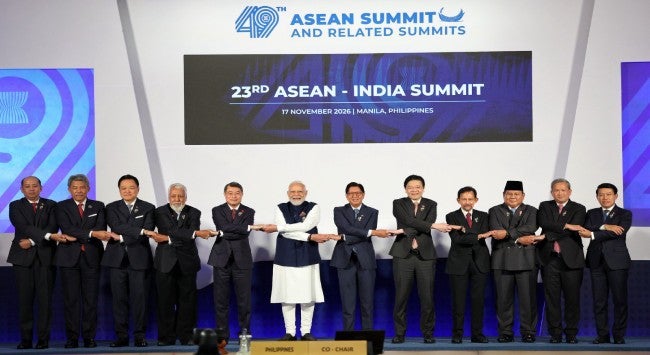
On the whole, the ASEAN-India Summit also offered little new. Indian Prime Minister Narendra Modi made several modest proposals, of which two stood out. He promised free e-visas for tourists from the ASEAN member countries although it is unclear as of now when and how this will be implemented. He also suggested ASEAN-India nuclear energy technical exchanges which is a well-timed offer, given that the Southeast Asian countries recently expressed interest in the technology as a response to the Middle East energy crisis.
As annual events, ASEAN Summits occupy an unusual place in the world of multilateralism. Although they cannot always deliver headline-grabbing breakthroughs, they are ideal mechanisms for making incremental progress over the long term. Their strength lies in their highly institutionalised design, stable membership core and broad underlying commitment to economic integration. They provide a powerful vehicle for an external actor like India, Japan, China or the US to steadily build their engagement with the region over years.
India is adept at the art of headline-grabbing summitry but has not been so successful in translating high-profile diplomatic engagements at ASEAN Summits into systematic, incremental progress. It is illustrative that Modi’s proposals during this year’s summit held few connections with the proposals he made last year or the year before that. The ad-hoc nature of India’s engagement with ASEAN is evident in the Plans of Action (PoA) that it develops with ASEAN every five years to guide the relations. For instance, on the energy front, the 2010-2015 PoA focused on oil and natural gas exploration and power grid integration. The 2016-2020 PoA highlighted the ‘ASEAN-India New and Renewable Energy initiative’. In the 2021-2025 plan, nuclear energy became the centre of attention.
Systematic progress is partly stymied because of the limited scope of India’s engagement with ASEAN. The ASEAN Summit is a generally a collection of several multilateral meetings packed together. Although India holds a comprehensive strategic partnership with ASEAN, it is a member of only a few of those multilateral arrangements. In Manila this week, Modi participated in the ASEAN-India Summit, the East Asia Summit (EAS) and the Quadrilateral Security Dialogue (Quad) Summit. In contrast, Japanese Prime Minister Sanae Takaichi attended the ASEAN-Japan Summit, EAS, Quad, ASEAN Plus Three Summit, Mekong-Japan Summit and the Asia Zero-Emission Community meeting. The Japanese also participated in the Regional Comprehensive Economic Partnership (RCEP) Ministers’ Meeting. After the summit, Takaichi flew to Shenzhen for the Asia-Pacific Economic Cooperation Summit. In other words, Japan was part of many more conversations in Manila than India.
India’s limited engagement with ASEAN+ institutions is an outcome of history. New Delhi sought to become a dialogue partner of ASEAN in 1976, but the initiative was stalled by the Cambodian conflict. It only became a full dialogue partner in 1996. It did not consider joining the Asia-Pacific Economic Cooperation (APEC) when it was formed in 1989. Three years later, when it sought APEC membership, the door was closed. India was not one of the early responders to the 1997 Financial Crisis. Resultantly, it was not included in ASEAN+3 that emerged out of the crisis. Finally, India decided to walk out of the RCEP in 2020 after years of negotiations.
Incremental progress is also impeded by the lack of follow-through. Indian diplomacy is capable of creative and bold ideas, but it fails to deliver. One instance is the Mekong-Ganga Cooperation (MGC) initiative. In the late 1990s, as Vietnam, Laos and Cambodia reconciled with ASEAN-5, economic development of the Mekong subregion became a salient issue. In 2000, India, which had already been providing aid to all these countries, formed the MGC with Thailand, Vietnam, Laos, Cambodia and Myanmar. India was the first external actor to initiate such a multilateral project. The MGC was followed by similar projects by the US (2009), Japan (2009), South Korea (2011) and China (2016). India’s headstart, however, did not translate into delivery. The MGC has been dormant for years whereas all the other initiatives – Mekong-US Partnership, Mekong-Japan Summits, Republic of Korea-Mekong Comprehensive Partnership and Lancang-Mekong Cooperation – have made substantial headway.
At the heart of the problem lies a lack of clarity on India’s agenda vis-à-vis ASEAN. There is no dearth of what New Delhi wants from the region: greater services trade, balanced goods trade, more tourists, more investments, cooperation to take advantage of China+1, markets for defence sales, security of the Malacca Straits, wellbeing of Indian diaspora and blocking Chinese influence. However, it lacks a coherent agenda that prioritises these goals and lays out a comprehensive strategy to pursue them.
The primary factor that drives India’s engagement with ASEAN is its desire to signal commitment to the region. Above all, India wants to convey that it plans to maintain presence in Southeast Asia and will continue to do so. It believes that such signalling is important for its ambitions to be recognised as a major actor on the world stage. However, without a clear and concrete agenda, such signalling can lead to multilateralism for multilateralism’s sake and summitry for summitry’s sake. Such an approach may end up tarnishing India’s image rather than burnishing it.
. . . . .
Dr Sandeep Bhardwaj is a Research Fellow at the Institute of South Asian Studies (ISAS), an autonomous research institute at the National University of Singapore. He can be contacted at sbhardwaj@nus.edu.sg. The author bears full responsibility for the facts cited and opinions expressed in this paper.
Pic Credit: X
-
 More From :
-
 Tags :
-
 Download PDF