


Summary
India’s participation in Pax Silica could strengthen access to technology, investment and diversified supply chains. Its strategic value, however, depends on converting membership into domestic capabilities and influence over coalition rules. New Delhi must balance trusted partnerships with regulatory autonomy, managing dependencies while securing a stronger role in technology production.
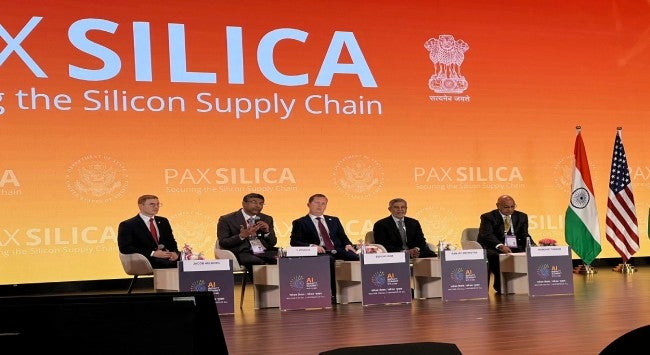
India’s signing of the San Francisco Declaration moves its participation in the United States (US)-led Pax Silica initiative towards practical economic-security cooperation. Covering minerals, semiconductors, energy, computing infrastructure and logistics, the arrangement links the industrial foundations of artificial intelligence (AI). Its value for India will depend on whether membership delivers domestic capabilities and influence over rules while preserving some autonomy.
On 15 November 2026, India joined nine partners in signing the declaration, following its entry into Pax Silica during the AI Impact Summit in New Delhi in February 2026. The declaration establishes common views of sensitive technologies. Five working groups will address policy issues, including AI adoption, supply-chain cooperation, security hubs and safe-harbour arrangements and AI security and resilience.
The declaration does not name China. Nevertheless, references to economic coercion, concentrated dependencies and hostile control indicate its purpose. Pax Silica seeks to translate concerns about concentrated technological and industrial power into coordinated economic-security policies. For India, the challenge is to secure the benefits of diversification while retaining discretion over commercial relationships and national law.
Thus, India’s entry and interest reflects the recognition that AI ambitions require more than software and models. They depend on electricity, advanced chips, manufacturing equipment, minerals, cloud infrastructure and secure communications. India brings engineering talent, market scale, semiconductor-design capabilities and digital public infrastructure. It is also expanding computing capacity and attracting investment in semiconductor fabrication, packaging and electronics manufacturing.
Yet dependencies persist. India relies on imported advanced semiconductors and manufacturing equipment, while Chinese components and production technologies remain embedded in electronics and clean-energy supply chains. Access to frontier AI accelerators depends on suppliers and export-control decisions outside India. Pax Silica could help address these gaps through investment, research partnerships, supplier diversification, and information sharing.
The opportunity extends beyond attracting factories. Economic-security policies increasingly scrutinise ownership, component origins, production equipment, financing and access to sensitive knowledge. India’s appeal as an alternative assembly location under ‘China+1’ will, therefore, be insufficient; it must develop domestic suppliers, higher-value production and credible safeguards across supply chains. Otherwise, relocation could reproduce dependence with a different geography.
Coalition members offer complementary strengths: Australian minerals, Japanese equipment and materials, South Korean semiconductors, Gulf capital and energy, British research, American computing technology and Indian engineering and demand. Connecting these assets could support distributed production networks. India should seek partnerships that build processing, design, research and manufacturing capabilities, with clear opportunities for Indian firms to acquire expertise and develop intellectual property.
However, three tensions exist. First, technology access may bring pressure to align export controls, investment screening, and restrictions on Chinese firms. India already limits certain Chinese investments and vendors but broader restrictions could raise industrial costs before alternatives become available. New Delhi should favour targeted measures tied to identifiable security risks, with sequencing that reflects domestic production needs.
Second, trusted dependence remains dependence. Diversifying from Chinese suppliers towards American chips or Japanese equipment can improve resilience without removing exposure to foreign licensing and export controls. India must distinguish access from capability. Research collaboration, supplier development, skills and technological ownership will determine whether partnerships expand its freedom of action. Purchasing trusted technology alone cannot deliver that outcome.
Third, India must shape the initiatives’ rules. Working groups will address consequential questions about sensitive technologies, investment safeguards, supply-chain hubs and regulatory differences. Effective participation requires coordination across external affairs, commerce, technology ministries. and security agencies. Without agreed priorities, India risks becoming principally a market and implementation location. Domestic institutional capacity will determine how effectively diplomatic access becomes negotiating influence. That requires clear negotiating mandates, regular consultation with industry and a shared assessment of which dependencies demand diversification and which require investment at home.
Pax Silica also adds another layer to India’s Indo-Pacific partnerships. Alongside the Quadrilateral Security Dialogue, bilateral technology agreements and cooperation with Europe, it could connect investment and supply-chain initiatives across the AI economy. Participation represents selective alignment around particular vulnerabilities, consistent with India’s effort to maintain wider diplomatic flexibility. However, deeper common rules could narrow the space for ambiguity between competing technology ecosystems.
India should use Pax Silica to widen its technology choices. Affordable digital infrastructure, multilingual AI and development partnerships could give cooperation regional value. This would require matching trusted supply with affordability and local needs. The declaration opens an institutional channel, but membership itself guarantees neither influence nor autonomy. India’s gains will depend on converting market scale and partnerships into capabilities, ownership, and a role in setting rules.
. . . . .
Dr Karthik Nachiappan is a Non-Resident Senior Fellow at the Institute of South Asian Studies (ISAS), an autonomous research institute at the National University of Singapore (NUS). He can be contacted at knach@visitor.nus.edu.sg. The author bears full responsibility for the facts cited and opinions expressed in this paper.
Pic Credit: (21) pax silica india – Search / X
-
 More From :
-
 Tags :
-
 Download PDF