


From Protest to Power: BNP, Student Politics
and Campus Violence in Bangladesh
Imran Ahmed, Sheikh Muzzammil Hussen
11 August 2026Summary
Bangladesh’s student organisations have played a defining role in the country’s democratic history, from the language movement to the July 2024 uprising. Yet this tradition has also coexisted with recurring episodes of campus violence involving the student wing of the governing party. Since the Bangladesh National Party assumed office in February 2026, allegations against Chhatra Dal have prompted questions about whether aspects of this historical pattern are re-emerging.
Student politics has long occupied a distinctive place in Bangladesh’s political life. Universities have served as centres of political mobilisation, with student organisations playing leading roles in some of the country’s most significant democratic and constitutional struggles. This pattern can be traced to the language movement of 1952 when student groups at Dhaka University formed the All-Party State Language Action Committee and led the protests of 21 February 1952. It continued through the 1962 movement against the Sharif Commission education report and the Six-Point campaign after 1966. In January 1969, the Sarbadaliya Chhatra Sangram Parishad transformed student demands into a nationwide uprising that eventually contributed to the fall of Ayub Khan. In March 1971, student leaders raised the flag of an independent Bangladesh and many later joined the liberation war. Nearly two decades later, a broad coalition of student organisations helped drive the movement that brought an end to Hussain Muhammad Ershad’s rule.
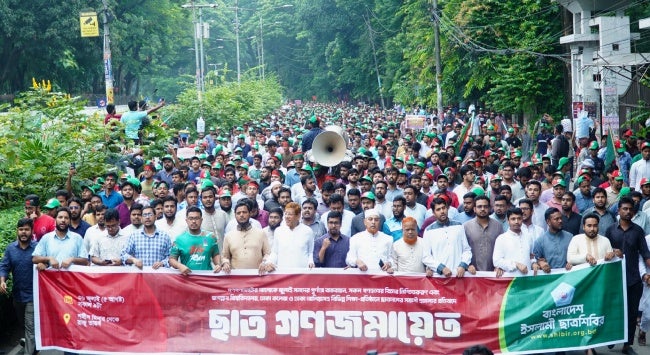
The July 2024 uprising continued this tradition of student-led political mobilisation. The movement brought together students from across the political spectrum. Activists from the Anti-Discrimination Student Movement, Chhatra Dal, Islami Chhatra Shibir, Chhatra Shakti, Bangladesh Chhatra Union and Chhatra Federation, together with large numbers of students with no party affiliation, mobilised against the government. Chhatra League, the student wing of the ruling Awami League, instead opposed the protests and was subsequently banned as a terrorist organisation in October 2024.
The prominent role of student organisations in Bangladesh’s political history has also had a more violent dimension. University campuses have experienced recurring conflicts involving party-affiliated student organisations, particularly during periods when their parent parties held national power. A survey published in Daily Janakantha in 2001 and cited by Banglapedia recorded 128 deaths and 4,290 serious injuries from campus violence in the three decades after 1974, including 72 deaths at Dhaka University. Some of the most serious incidents involved organisations that were affiliated with both the Awami League and the Bangladesh Nationalist Party (BNP). In 1998, for example, allegations of rape against Jasimuddin Manik, the general secretary of the Chhatra League unit at Jahangirnagar University, prompted a year-long student protest that eventually forced him out of the campus. During the BNP’s subsequent period in government, factional violence within Chhatra Dal over construction tenders resulted in the death of Bangladesh University of Engineering and Technology student Sabekun Nahar Sony in 2002.
This historical pattern provides important context for recent developments on Bangladesh’s university campuses. In August 2025, Chhatra Dal announced convening committees for all 18 residential halls at Dhaka University. What makes this significant is that residential halls have historically provided student organisations with an important base from which to exercise influence over campus life and student politics. More recently, the organisation has faced allegations of involvement in violence. On 23 April 2026, around 20 to 30 Chhatra Dal activists were accused of assaulting two elected Dhaka University Central Students’ Union (DUCSU) members, Musaddiq Ali Ibne Mohammad and A B Zubair, inside Shahbagh Police Station. At least 10 people, including journalists, were reportedly injured. The two DUCSU members later served a legal notice after police declined to record a case.
A series of violent incidents in early August 2026 added to these concerns. On 3 August 2026, clashes between Chhatra Dal and Islami Chhatra Shibir at Begum Rokeya University in Rangpur began following a dispute over a banner displayed at an exhibition on the July 2024 uprising. At least 25 students were injured, five of them critically. The following day, both organisations announced rival protest programmes, raising concerns about further violence. The university authorities subsequently imposed Section 144, temporarily prohibiting processions, public meetings and rallies on campus. Violence also broke out at Jagannath University on 4 August 2026 after representatives of the elected student union and members of Inqilab Mancha were prevented from entering a University Grants Commission event. Several student leaders were among those injured, while the campus medical centre was also vandalised. Chhatra Dal denied leading the violence and maintained that ordinary students had resisted what it described as a ‘mob’. Further clashes involving Chhatra Dal and Shibir were reported the same day at Dhaka College while fighting also occurred at Dhaka Alia Madrasah over control of residential hall seats.
These developments have prompted wider concerns about the direction of student politics on university campuses. At Rajshahi University of Engineering & Technology, students called for a referendum on banning campus politics after a banner opposing political activity was burned while teachers at a national roundtable warned of a return to a culture of fear at universities. Recent incidents do not necessarily mean that Bangladesh has returned to the patterns of campus violence seen in earlier periods, but they provide reason for concern. The challenge is not simply to prevent violence but to preserve the political character of universities without allowing them to become extensions of struggles for party power. Bangladesh’s history demonstrates the extraordinary capacity of students to challenge authority and widen the possibilities of political change. The question now is whether that same tradition can resist reproducing the practices it once challenged when those it helped bring to office become the new establishment.
. . . . .
Dr Imran Ahmed is a Research Fellow at the Institute of South Asian Studies (ISAS), an autonomous research institute at the National University of Singapore (NUS). He can be contacted at iahmed@nus.edu.sg Mr Sheikh Muzzammil Hussen is a Research Intern in the same institute. He can be contacted at isav47@partner.nus.edu.sg. The authors bear full responsibility for the facts cited and opinions expressed in this paper.
Pic Credit: X
-
 More From :
-
 Tags :
-
 Download PDF