


Summary
Opening the China-India border trade is an important symbolic step but trade is too small and restricted to influence relations, reflecting India’s conundrum between border trade and border security. New Delhi has chosen security.
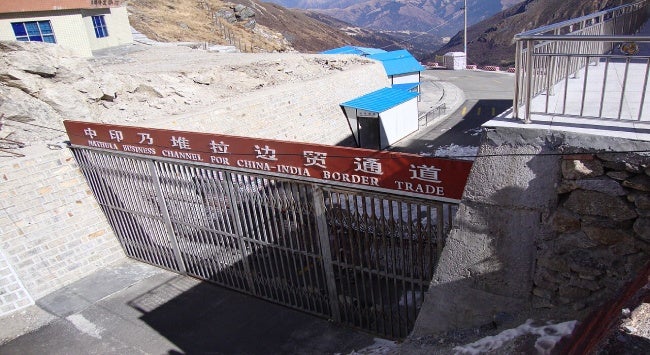
On 1 August 2026, the China-India border trade resumed after six years of suspension. Following an agreement announced last August during Chinese Foreign Minister Wang Yi’s visit to New Delhi, the two sides opened three passes for border trade Nathu La in Sikkim, Lipulekh in Uttarakhand and Shipki La in Himachal Pradesh. The significance of this reopening is primarily symbolic and political rather than economic. It proves that the recent thaw in China-India relations, which followed years of frozen relations, is yielding results and signals that both sides continue to seek to an improved relationship despite their ongoing rivalry.
Border trade, especially through Nathu La, has long served as a barometer of China-India relations. Nathu La, the main border crossing between India’s Sikkim and China’s Tibet, witnessed military clashes during the 1962 China-India war and in 1967 and remained closed for decades after the war. As China-India relations improved in the 1990s, border trade resumed through Lipulekh pass and then Shipki La. Eventually, Nathu La was officially reopened with fanfare in 2006, following a 2003 deal between Beijing and New Delhi that recognised the Tibetan Autonomous Region as part of China and Sikkim as part of India. Despite the symbolism, border trade remained small and declined sharply after the 2017 Doklam standoff. The huge 2020 border crisis halted all border trade and closed the passes. The thaw between Beijing and New Delhi, which began in October 2024, overcame the post-2020 freeze in relations and reopened the border passes. In 2025 Nathu La and Lipulekh were reopened for the resumed Kailash Mansarovar Yatra and, hence, paved the way for the current resumption of border trade.
Will the resumption have any impact on China-India relations? As a confidence-building measure, the reopening is likely to improve relations slightly. The logic behind border trade has been to establish economic and people-to-people contacts that stabilise the border. Nevertheless, border trade is too small and too restricted to effect substantial change and stabilise the border. At its peak in 2016, it stood at US$9.5 million (S$12.3 million, a drop in the ocean of China-India trade, which was US$65 billion (S$84 billion) in 2016 and reached US$155 billion (S$200 billion) in 2025. Border trade is also heavily restricted. On the Indian side, it is carried by a small number of registered traders (600 in Sikkim before 2020), held four days a week from May to November and features 36 goods for export and 20 for import. The goods are all with little added value and include tea, rice, tobacco, handicrafts, clothing, wool, sheep and yak hair.
Why has border trade been so small and restricted? Both China and India have their reasons. For India, the main reason is that border trade represents a veritable Catch-22. On one hand, border trade needs to grow substantially to build economic and people-to-people links between the two sides and, hence, improve India’s security around the border. On the other hand, however, India needs to enjoy much greater security on the border to allow border trade to grow in the first place. In short, India’s conundrum is that in the face of a much more powerful China, it cannot have simultaneously substantial border trade and border security. Hence, India has chosen border security over border trade and kept border trade small, restricted and conducted through three passes. This is a sensible choice for India for two reasons.
First, border trade has larger military implications. Nathu La connects with the strategically crucial Chumbi valley that sits next to the crucial China-India-Bhutan trijunction and close to India’s narrow and vulnerable Siliguri corridor which links India’s often unstable Northeast with the rest of the country. Due to this strategic importance, Chumbi valley and the areas around it have long been contested between the Chinese and the Indian militaries and have witnessed tensions, clashes and competitive infrastructure building. From India’s perspective, massive trade through Nathu La might facilitate Chinese military and intelligence activities in the valley and the adjacent areas and play a role in a military crisis. To lesser extent, such military concerns exist at Shipki La, through which the Sutlej flows from China into India, and Lipulekh pass, which sits at the sensitive trijunction between China, India and Nepal in an area disputed between New Delhi and Kathmandu.
Second, border trade is likely to expand Chinese presence, both economic and human, in India’s sensitive and partly disputed borderlands. As some parts of the border, especially in the east, are insufficiently integrated with the rest of India, underdeveloped and often inhabited by minorities, border trade with China might undermine India’s position in them. Sikkim, connected to China through Nathu La, is particularly sensitive in this respect, as the state did not accede to India until 1975 and its status as part of India was not recognised by Beijing until 2005, a recognition often seen as partial and uncertain. Crucially, border trade might also expand Chinese presence in areas claimed by Beijing, de facto allowing Chinese economic power to begin integrating some of these areas into China, especially in Arunachal Pradesh. Moreover, border trade is likely to enable Beijing to better monitor and influence the Tibetan community and Tibetan religious institutions along the border, in preparation for the reincarnation of the Dalai Lama.
In sum, India prefers to keep its border trade with China small, localised and restricted because it poses substantial security risks. Essentially, India has chosen border security over border trade. Hence, the current reopening of border trade is of limited importance. While sensible, this choice comes with a price. Border trade is unlikely to bring security and stability to the border, but it can cushion tensions and soften the situation on the border.
. . . . .
Dr Ivan Lidarev is a Research Fellow at the Institute of South Asian Studies (ISAS), an autonomous research institute at the National University of Singapore (NUS). He can be contacted at ivanlidarev@nus.edu.sg. The author bears full responsibility for the facts cited and opinions expressed in this paper.
Pic Credit: Wikimedia Commons
-
 More From :
-
 Tags :
-
 Download PDF