


India’s National Security Strategy:
Critical and Emerging Technologies
Karthik Nachiappan
4 August 2026Summary
Critical and emerging technologies are becoming central to India’s national security strategy, reshaping military modernisation, deterrence, cyber and space security, economic resilience and strategic partnerships.
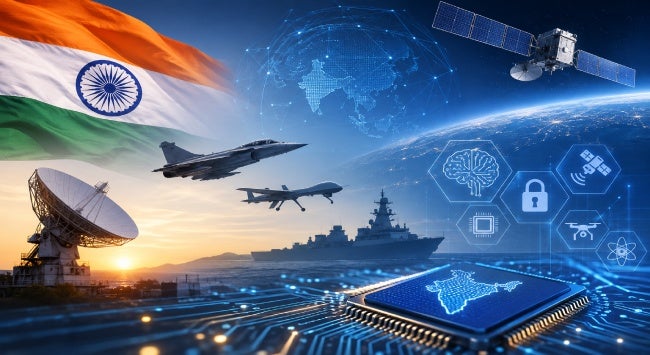
Critical and emerging technologies (CETs), including artificial intelligence (AI), semiconductors, cyber capabilities, quantum technologies, drones, advanced communications and space systems, are increasingly central to India’s evolving national security strategy. These technologies are reshaping how India prepares for conflict, protects its economic interests, manages strategic competition and structures its partnerships. For Indian policymakers, technological capability is no longer simply an economic issue but a foundational component of national power. As geopolitical competition intensifies, CETs are becoming essential to India’s ability to secure its borders, maintain deterrence and enhance its strategic autonomy.
First, emerging technologies are transforming India’s approach to military modernisation and future warfare. Modern conflict is increasingly defined by information dominance, autonomous systems and data-driven decision-making. The Indian armed forces are gradually integrating AI-enabled systems into surveillance, intelligence analysis and battlefield management to improve situational awareness and accelerate decision cycles. Autonomous systems and drones are also gaining prominence. India has expanded investments in unmanned aerial vehicles and counter-drone systems, particularly in response to evolving threats along its borders and the proliferation of drones in contemporary conflicts. Similarly, space-based capabilities, including satellite surveillance, communication systems and navigation technologies, are increasingly essential for modern military operations. Taken together, these technologies enhance India’s ability to monitor contested borders, conduct precision operations and operate in networked battlespace.
Second, CETs are reshaping deterrence and strategic stability, particularly in relation to China and Pakistan. India faces a complex security environment that includes conventional military competition, nuclear deterrence dynamics and growing risks of cyber and hybrid warfare. Emerging technologies play a growing role in managing these risks. Cyber capabilities are increasingly important for protecting critical infrastructure and military networks while also contributing to deterrence by signalling the ability to respond to cyber aggression. AI and advanced analytics also support early-warning systems by enabling faster processing of intelligence and surveillance data. While these technologies offer advantages, they also compress decision timelines and introduce new escalation risks. As a result, India must balance the adoption of emerging military technologies with mechanisms to manage instability and miscalculation.
Third, CETs are expanding the domains of national security competition. Traditionally, India’s security strategy focused on land borders and maritime security in the Indian Ocean. Today, national security increasingly extends to cyber space, outer space and digital infrastructure. Cybersecurity has become critical as digital networks underpin financial systems, government services and military communications. India has responded by strengthening cyber institutions, improving incident response capabilities and investing in digital resilience. Space is another increasingly important domain. Satellite systems provide navigation, communications and intelligence that are essential for both civilian and military applications. India’s development of counter-space capabilities and growing investments in space-based infrastructure reflect the recognition that technological superiority in space can shape outcomes on Earth. These developments underscore how emerging technologies are broadening the scope of strategic competition.
Fourth, India’s national security strategy increasingly links technological capability with economic security and industrial resilience. Dependence on foreign technology supply chains, especially in areas such as semiconductors, telecommunications infrastructure and advanced electronics, has become a strategic vulnerability. As a result, India has launched a range of initiatives to strengthen domestic innovation and manufacturing. Policies promoting self-reliance in defence production and advanced technologies aim to build domestic supply chains, encourage private-sector participation and expand India’s defence technology ecosystem. Initiatives supporting startups and innovation in defence technology seek to accelerate the development of indigenous capabilities in areas such as AI, robotics and advanced sensors. The goal is not complete technological independence but greater resilience and bargaining power in an increasingly fragmented global technology landscape.
Fifth, CETs are reshaping India’s technology diplomacy. Access to advanced technologies increasingly depends on international collaboration. India has, therefore, deepened technology partnerships with major powers and like-minded states across the Indo-Pacific and beyond. Cooperation with partners such as the United States, Japan, Australia and Europe increasingly focuses on semiconductors, defence innovation, AI and critical supply chains. These partnerships serve several strategic purposes. They help India access cutting-edge technologies, diversify supply chains and reduce dependence on any single partner. At the same time, India seeks to maintain strategic autonomy by avoiding overly rigid technological blocs. This balancing approach reflects India’s broader foreign policy tradition while recognising that technology ecosystems are increasingly shaped by geopolitical competition.
Looking ahead, CETs will continue to shape India’s national security strategy in several ways. The pace of technological change means that India must continuously adapt its military doctrines, regulatory frameworks and innovation ecosystems. Building the necessary human capital – engineers, researchers and skilled technicians – will be just as important as acquiring hardware. Moreover, technological competition is increasingly intertwined with economic policy, industrial strategy and international diplomacy. Managing this intersection will be one of the central challenges of India’s strategic planning.
CETs are redefining the foundations of India’s national security strategy. They influence how India modernises its military, strengthens deterrence, protects critical infrastructure, develops domestic technological capabilities and engages with international partners. As technological competition intensifies globally, India’s ability to harness these technologies effectively will play a decisive role in shaping its strategic position in the Indo-Pacific and the broader international order.
. . . . .
Dr Karthik Nachiappan is a Research Fellow at the Institute of South Asian Studies (ISAS), an autonomous research institute at the National University of Singapore (NUS). He can be contacted at isaskn@nus.edu.sg. The author bears full responsibility for the facts cited and opinions expressed in this paper.
Pic Credit: Chatgpt
-
 More From :
-
 Tags :
-
 Download PDF