


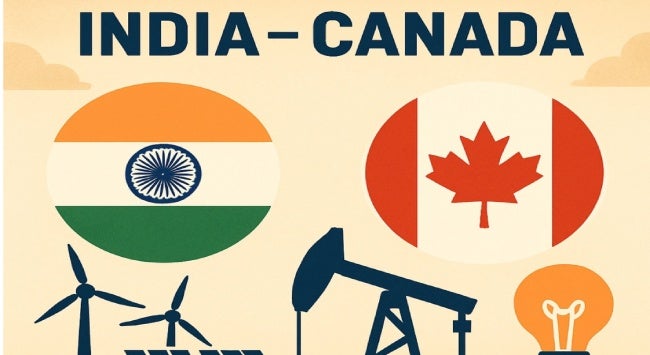
Stabilising India-Canada Relations:
Anchoring the Partnership in Energy
Karthik Nachiappan
3 August 2026Summary
India and Canada have an opportunity to stabilise their relationship around an area of mutual interest: energy. Cooperation on critical minerals, clean fuels, grid modernisation, nuclear power and finance can align India’s growing energy needs with Canada’s diversification ambitions, while creating economic and strategic ballast against future political disruptions.
Canadian Prime Minister Mark Carney’s 2026 visit to India underscored the effort by both governments to rebuild a relationship that has weathered serious political strain. As India recalibrates its economic and strategic trajectory and Canada seeks deeper partnerships across the Indo-Pacific, the challenge now is to translate the diplomatic reset into a durable agenda for cooperation. Energy offers the strongest foundation for doing so.
That foundation could be energy. When bilateral ties are disrupted by a high-salience political dispute, the fastest route back to productive engagement is to build a larger domain of mutual interest – one that is measurable, economically grounded and politically defensible. For India and Canada, energy is that domain.
Energy is not an easy area. However, it is where both countries’ structural needs and comparative advantages overlap in ways that can outlast political cycles and provide real ballast. India requires long-term supply security, capital, technology and diversified partnerships to manage both growth and decarbonisation. Canada is seeking export diversification, investment destinations and credible climate-aligned partnerships in the Indo-Pacific. The alignment is structural, not tactical.
It is also already embedded in official language. Both governments have framed cooperation around ‘energy security’, ‘climate goals’ and ‘sustainable economic development’. Framing matters. It creates a rationale for engagement that can resonate across domestic constituencies – business groups, regulators, provincial governments and industrial actors – who need tangible reasons to sustain the relationship.
The demands on India’s energy system are immense. Natural Resources Canada recently described India as the world’s third-largest oil consumer, fourth-largest liquefied natural gas importer and a major refining hub, projecting it to account for over one-third of global energy-demand growth in the coming decades. Whether every projection materialises is secondary to the strategic reality: India will remain central to global energy markets and the clean transition. A sustained partnership with Canada – an energy exporter seeking diversified markets – is, therefore, economically rational.
Energy cooperation should rest on five practical pillars. The first is critical minerals and processing supply chains. India is actively negotiating critical-minerals partnerships to reduce dependence on China-dominated supply chains and secure processing technologies. Canada is a major upstream producer but remains under-embedded in India’s mineral strategy compared to Australia and the United States.
The second is clean fuels. Both governments have identified hydrogen, biofuels and sustainable aviation fuel as priority areas. Canada can contribute project finance expertise and export optionality; India brings scale, demand growth and increasingly competitive renewable power. Structured collaboration here would link industrial strategy with climate objectives.
The third is grid integration and power-system modernisation. This is less visible but potentially transformative. India’s renewable expansion increasingly hinges on grid reliability, storage and digitalisation. Canada has deep expertise in electricity-system management and grid resilience. Technical exchanges, pilot projects and regulatory cooperation in this area are low-risk but high-impact.
The fourth is nuclear energy. The institutional foundation already exists under the Canada-India Nuclear Cooperation Agreement. Canada is one of the world’s largest uranium producers; India is expanding nuclear power to diversify away from coal and enhance energy security. Both countries are exploring small modular reactors. While politically sensitive, civilian nuclear cooperation – from fuel supply to regulatory exchanges – could become a quiet but strategic pillar of the partnership.
The last is finance and project execution. Canada has accelerated major energy and resource projects domestically while Indian officials point to vast investment opportunities across their energy value chain. The bilateral challenge is not ambition but structure: co-financed pilot projects, dedicated green-finance channels and institutionalised investment platforms that connect capital with execution.
None of this erases the political risks that have destabilised the relationship. Diaspora politics, law enforcement disputes and sovereignty concerns will not disappear. An energy-first strategy works only if both sides consciously separate tracks – addressing justice and security concerns through dedicated diplomatic channels while insulating economic cooperation from day-to-day political retaliation.
There are also domestic constraints. In Canada, export diversification intersects with provincial politics, Indigenous consultation and climate commitments. In India, energy deals are shaped by industrial policy priorities, pricing politics and development imperatives. Neither side can ignore these realities. Cooperation must be designed to visibly benefit domestic stakeholders.
If done seriously, an energy-centred partnership would generate effects that extend beyond bilateralism. Economically, it links Canada’s export diversification agenda with India’s long-term demand growth and industrial expansion. Geopolitically, diversified mineral and fuel supply chains reduce over dependence on any single dominant supplier and align with broader de-risking strategies. Climate-wise, pairing gas, grids, clean fuels and minerals offers one of the few pragmatic pathways to manage transition risks while sustaining growth.
Most importantly, energy can build a durable domestic coalition – firms, investors, regulators and provincial or state governments – with a material stake in keeping the relationship functional even when politics turns difficult.
India-Canada relations need a concrete agenda that produces tangible benefits quickly and runs deep enough to weather political storms. Energy meets that test. If both sides are serious about a reset, this is where they should begin.
. . . . .
Dr Karthik Nachiappan is a Research Fellow at the Institute of South Asian Studies (ISAS), an autonomous research institute at the National University of Singapore (NUS). He can be contacted at isaskn@nus.edu.sg. The author bears full responsibility for the facts cited and opinions expressed in this paper.
Pic Credit: Shutterstock
-
 More From :
-
 Tags :
-
 Download PDF