


Powering the Future:
A New India-Singapore Energy Partnership
Karthik Nachiappan, Mriganika Singh Tanwar
24 July 2026Summary
India and Singapore can combine strengths to advance clean energy, green shipping and sustainable digital infrastructure. Linking India’s scale, industrial capacity and renewable potential with Singapore’s finance, technology and regulatory expertise can deliver practical projects, strengthen economic resilience and offer scalable models for their green and digital transitions.
India and Singapore are deepening their partnership when economic security, technological competition and climate pressures are reshaping the global economy. Once treated as largely separate policy domains, energy, transport and digital infrastructure are linked. Energy systems must support expanding industrial demand; ports and shipping networks must adapt to cleaner fuels and digital operations; and data centres must grow without overwhelming power grids and water resources. These shifts create new opportunities for bilateral cooperation but they also require both countries to move beyond aspirations towards practical projects, common standards and sustained institutional coordination.
The geopolitical context makes this cooperation more urgent. The current Gulf war and standoff over the Strait of Hormuz have exposed the vulnerability of international energy markets. Price spikes, higher freight costs, shipping risks and renewed concerns over supply security have reinforced the costs of dependence on volatile fuel markets and concentrated supply chains. Simultaneously, intensifying strategic competition over clean technologies, critical minerals, semiconductors, data and artificial intelligence (AI) is changing how governments operate. The energy transition and digital transformation are no longer viewed as purely environmental or innovation focused agendas; they are central to economic resilience, industrial competitiveness and national security.
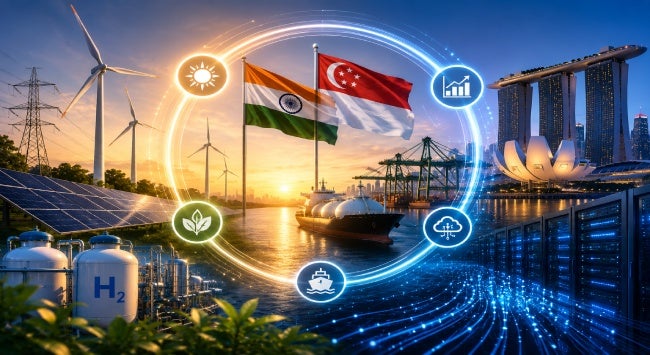
India and Singapore bring distinct but complementary strengths to these challenges. India offers market scale, industrial capacity, renewable-energy potential, a large workforce and rising demand for energy, maritime and digital infrastructure. Singapore contributes capital, regulatory expertise, advanced infrastructure, technological capabilities and critical connections to international markets. That said, their differences create interdependencies. India requires investment, technologies and operational expertise to accelerate implementation, while Singapore’s limited land, energy and domestic market make external partnerships essential to its long-term competitiveness. Bilateral cooperation on three issues – clean energy systems, maritime decarbonisation and sustainable digital infrastructure can link India’s scale and production capacity with Singapore’s strengths as a financial, technological and logistical hub.
First, there is greater scope for cooperation on clean-energy systems. Both countries face rising electricity demand, their energy systems differ in scale, structure and resource availability. India has to expand renewable generation, storage and grid capacity while maintaining affordability and reliability. Singapore, constrained by limited domestic renewable resources, is pursuing efficiency, innovation and regional energy connectivity. Bilateral cooperation could focus on grid modernisation, energy storage, clean-technology manufacturing, investment and regulatory exchange.
Second, potential exists to deepen links on green shipping and maritime decarbonisation. India is seeking to align maritime modernisation with its green industrial ambitions and its goal of becoming a leading maritime power by 2047. Singapore, meanwhile, must decarbonise without weakening its position as a major global port and hub. The Singapore-India Green and Digital Shipping Corridor provides an institutional framework for cooperation on alternative fuels, port electrification, digital systems, workforce training and finance. India’s potential to produce green fuels complements Singapore’s expertise in bunkering, certification, port management and international connectivity.
Third, opportunities exist for both countries to build sustainable digital infrastructure. Data centres are becoming indispensable to cloud services, digital payments and AI but their expansion is stressing electricity grids and water supplies. India is rapidly increasing its computing capacity as part of its wider AI ambitions, yet sustainability standards and integrated regulatory oversight remain uneven. Singapore has adopted a ‘Green First’ model, using efficiency requirements and careful capacity allocation to reconcile digital growth with land and energy constraints. Bilateral cooperation could support next-generation cooling systems, shared sustainability reporting, efficient data-centre design and standards for compute sharing, green AI hosting and trusted cross-border data arrangements.
Though addressed separately, the three issues are connected. Data centres require reliable low-carbon electricity; green ports depend on electrification, alternative fuels and digital management; and clean-energy manufacturing relies on resilient maritime and data networks. Bilateral initiatives could be designed around these connections and opportunities. For example, renewable-energy efforts could support port electrification and data-centre growth, while digital technologies could improve grid management, vessel efficiency and emissions reporting.
The broader implication is that India-Singapore cooperation can serve as a model of green and digital development between partners with different yet critical capabilities. Success will depend less on announcing additional frameworks than on selecting bankable projects, aligning regulations, mobilising private capital and training the necessary workforce. Future cooperation could extend beyond just the bilateral relationship given the opportunities that exist to craft workable standards and technologies that could be adapted across Southeast Asia and the Indo-Pacific.
These three energy issues offer India and Singapore an opportunity to make their strategic partnership more integrated and implementation-oriented. By connecting energy security, maritime decarbonisation and sustainable digitalisation, both countries can strengthen resilience while contributing solutions to the region’s green transition and digital transformation.
. . . . .
Dr Karthik Nachiappan is a Research Fellow at the Institute of South Asian Studies (ISAS), an autonomous research institute at the National University of Singapore (NUS). He can be contacted at isaskn@nus.edu.sg. Ms Mriganika Singh Tanwar is a Research Analyst at the same institute. She can be contacted at m.tanwar@nus.edu.sg. The authors bear full responsibility for the facts cited and opinions expressed in this paper.
Pic Credit: Chatgpt
-
 More From :
-
 Tags :
-
 Download PDF