


Summary
Myanmar’s newly-elected President Min Aung Hlaing chose India for his first foreign visit in his current capacity. From India’s perspective, there are good reasons to engage with the government in Nay Pyi Taw. This brief examines the rationale for the resumption of high-level engagement on both sides and where this might lead.
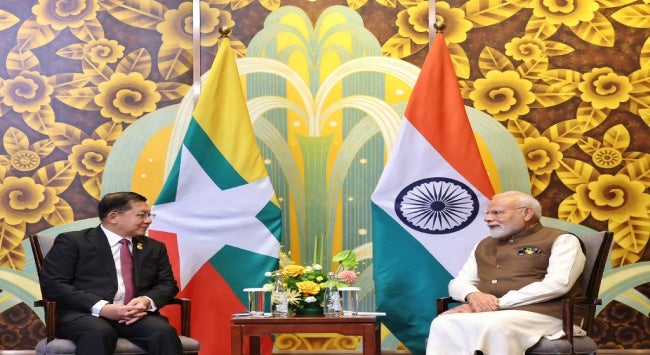
The first foreign tour of Myanmar’s newly-elected President Min Aung Hlaing was to India (30 May to 3 June 2026) before he visited China and Laos. The visit, at the invitation of India’s Prime Minister Narendra Modi, was originally framed in the context of the Summit of the International Big Cat Alliance, which was postponed due to the Ebola outbreak in Africa.
The two leaders had met twice earlier – both on the margins of multilateral events – the Bay of Bengal Initiative for Multi-Sectoral Technical and Economic Cooperation Summit in Thailand in April 2024 and the Shanghai Cooperation Organisation Summit in Tianjin in August 2025.
This first high-level bilateral visit between the two countries in six years has its own significance for both countries and the region.
Min Aung Hlaing was accompanied by a large official delegation comprising five Cabinet ministers, three deputy ministers as well as a business delegation and bilateral friendship association members. Bilateral trade presently exceeds US$2 billion (S$2.6 billion) annually of which over US$1.5 billion (S$1.9 billion) is Myanmar’s exports to India. The Governor of the Central Bank of Myanmar was also part of the delegation and strengthening of the Rupee-Kyat payment mechanism was pursued. The Myanmar leader also addressed a Trade and Investment Conclave in New Delhi and visited Mumbai. Power and infrastructure were the areas of interest to the Myanmar delegation. Min Aung Hlaing’s visit to the Mahabodhi Temple in Bodh Gaya further underlined the spiritual connection between India and Myanmar.
A Joint Statement was issued at the end of bilateral talks between the two leaders. This, and the remarks to the media by India’s Foreign Secretary Vikram Misri, identified the broad areas of discussion.
Although no memoranda of understanding (MoU) were signed during the visit, both sides noted the ongoing discussions on various bilateral agreements and MoU and looked forward to their early conclusion.
Both sides agreed to increase bilateral trade, including through the Rupee-Kyat settlement mechanism. The number of scholarships for Myanmar students was increased from 36 to 100 from 2026 onwards.
The discussions reaffirmed India’s support for efforts to restore peace, stability, national reconciliation and economic recovery in Myanmar, alongside its willingness to continue providing technical and developmental assistance. They also underscored the growing emphasis India places on institutional capacity-building, including sharing its experience in federalism and fiscal federalism as potential governance models for managing diversity and accommodating regional aspirations in Myanmar.
The leaders also discussed the need for enduring peace in Myanmar through an inclusive process involving all stakeholders, as well as the importance of restoring democracy. India conveyed its concerns over security and stability along the border and underscored the need for the early completion of the Kaladan Multi-Modal Transit Transport Project and the India-Myanmar-Thailand Trilateral Highway Project. Myanmar assured its full cooperation in completing both projects. Min Aung Hlaing also reiterated Myanmar’s commitment that its territory would not be used against India’s security interests.
From India’s perspective, although the trip was classified as an official visit rather than a state visit, as would normally be the case for a visiting head of state, the programme – apart from the ceremonial distinctions – included all the elements and courtesies customarily extended to a visit at that level.
There are several reasons why India appears to have adopted a more active policy of engagement with Myanmar. The protracted conflict has generated a range of security challenges for India. According to the United Nations (UN), Myanmar has overtaken Afghanistan as the world’s largest producer of opium. Drug and arms trafficking along the 1,643-kilometre India-Myanmar border have become growing concerns, while human trafficking linked to cyber scam centres has emerged as another major challenge. More than 2,400 Indians have been repatriated from such scam centres in the past year alone. The arrest of an American and six Ukrainian nationals allegedly involved in supplying drone technology and training across the border into Myanmar has further underscored the deteriorating security situation.
In response, India has suspended the Free Movement Regime, which previously allowed residents on either side of the border to travel up to 16 kilometres across without a visa. Given the deep familial and social ties between border communities, the suspension has caused inconvenience and some local disaffection. India is also constructing a barbed-wire fence with designated entry points to curb illicit cross-border activities. At the same time, the influx of refugees from Myanmar, particularly into Mizoram, has placed additional pressure on local resources. The continued presence of Indian insurgent groups operating from Myanmar further complicates the security landscape.
There has been criticism in the region that the visit confers legitimacy on Myanmar’s new government, given that its recent elections were widely regarded as neither free nor fair. India’s position, however, is that while reconciliation, peace and stability in Myanmar remain works in progress, engagement is the only viable approach. As Misri told the media, “India believes that sustained dialogue and not disengagement with neighbours such as Myanmar is necessary. Disengagement does not bring about any results and certainly does not produce democratic change. It only produces a vacuum that is filled by those who have no interest in democracy. We conveyed our views regarding the peace process and the importance of having all stakeholders as part of the dialogue at the table.”
Looking ahead, India is also likely to deepen engagement with other actors in Myanmar, many of whom exercise effective control over border areas, influence the implementation of connectivity projects and oversee access to critical mineral resources. This message was almost certainly conveyed to the authorities in Nay Pyi Taw.
More broadly, the visit reflects the Myanmar government’s desire to broaden its political and economic engagement and expand its strategic options.
. . . . .
Ambassador Jaideep Mazumdar is a Distinguished Visting Research Fellow at the Institute of South Asian Studies (ISAS), an autonomous research institute at the National University of Singapore (NUS). He is also India’s former Secretary (East). He can be contacted at jaideep.mazumdar@nus.edu.sg. The author bears full responsibility for the facts cited and opinions expressed in this paper.
Pic Credit: X
-
 More From :
-
 Tags :
-
 Download PDF