


Post-uprisings in South Asia:
Decoding the Divergent Political Trajectories
Ratan Kumar Roy, Roshni Kapur
22 May 2026Summary
The election in Nepal in early March 2026 saw the Rastriya Swatantra Party (RSP) voted to power with a landslide victory over more established and older political actors such as the Nepali Congress, Nepali Communist Party and the Communist Party of Nepal (United Marxist-Leninist). The RSP’s victory has been attributed to its campaigning on issues of anti-corruption, weak rule of law and limited domestic job opportunities that prompted many, particularly the youth, to migrate overseas. This paper explores how the uprisings that unfolded in South Asia were driven by distinct national contexts and factors leading to different political trajectories. While Sri Lanka witnessed a return to elite-managed politics after the Aragalaya, Bangladesh and Nepal experienced transitional governments that sought to address the popular movement goals.
Introduction
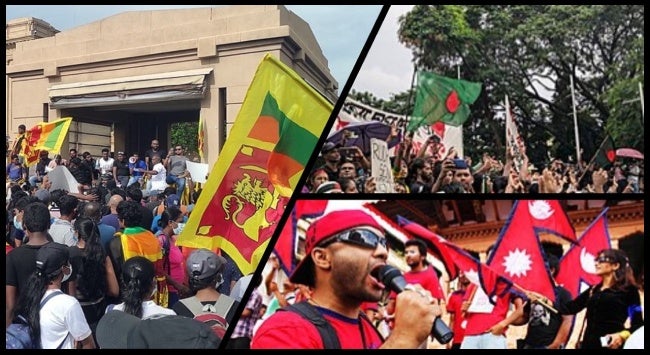
In the last four years, three countries in South Asia have experienced unexpected shifts in their domestic politics through broad-based movements that highlighted sentiments of frustration and anger.[1] The uprisings visibly displayed frustration with patronage politics, elite capture and corrosive political culture, and raised questions on the identity and character of the state. While they were driven by distinct factors of economic and political deprivation, they brought demands for reform, accountability and democratic renewal to the forefront of public life.[2]
The uprisings in Sri Lanka, Bangladesh and Nepal demonstrated strength and power of how broad-based movements can lead to the ouster of governments. While Sri Lanka has reached a certain level of stability, Bangladesh and Nepal continue to experience challenges that typically manifest during transitional periods. This paper discusses the triggers of each movement, challenges during the interim period and the return to parliamentary politics following the elections.[3] It also explores the extent of political will to restore state capacity, reform institutions and strengthen accountable governance with an overarching objective of changing the structure of the state. The political shifts also raise broader questions on why protests and periods of political instability did not coalesce into uprisings in neighbouring countries and why the threshold of violence differed.
From Street Politics to Post-Election Reform
The political mobilisation across the region warrants attention on whether aspirations for change have translated into meaningful reforms, governance and stability. In Sri Lanka, the Aragalaya (People’s Struggle), that ousted President Gotabaya Rajapaksa, first produced an elite-managed restoration when parliament elected Ranil Wickremesinghe as President after Gotabaya’s ouster in July 2022.[4] This alignment between the two key ideological political camps further accelerated public resentment towards the established old guard.[5] While Wickremesinghe initially showed support for the movement, his position altered after he came to power by cracking down on protesters, labelling them as “fascists” and “terrorists” and invoking the Prevention of Terrorism Act against them.
The elite consensus saw a reversal when the National People’s Power (NPP), led by Anura Kumara Dissanayake, won the presidency and 159 seats in the parliament, up from just three seats in the previous election. While the NPP was not in the frontlines of the Aragalaya, it managed to inherit public support and carry the mantle seeking substantial political and economic reforms. The party successfully managed to elevate its anti-elitist and anti-establishment populist slogan of constructing a new social contract centred on transparency, good governance, accountability, the rule of law and anti-corruption.[6] It has also shifted the discourse from ethnic politics and ethno-nationalism to one of anti-corruption and accountability. This new brand of populist politics has been possible given that the older and more established political parties continue to face a legitimacy crisis.[7]
Bangladesh has moved in a unique direction. The 2024 uprising that removed Prime Minister Sheikh Hasina from power saw the country governed by an interim government with a mandate to introduce constitutional and political reforms before elections are convened.[8] However, the interim regime adopted a zero-sum approach of pursuing retributive politics amid a deterioration in law and order. The general election held in February 2026 revealed a striking duality: a ‘return’ to the old order, with power handed back to the Bangladesh Nationalist Party through a two-thirds majority, alongside strong public support in the referendum for implementing the July Charter.[9] Although extensive discussions were held with many political parties to forge a political consensus before signing the Charter, the process was deemed as largely patriarchal, non-transparent, elitist and lacking inclusion. This consensus, at best, can be termed as an ‘elite consensus’ where the reform process was not effectively communicated to the public.
In terms of electoral outcome, Nepal has steered in a similar direction as Sri Lanka when the Rastriya Swatantra Party (RSP) secured 182 of 275 seats in the recent election.[10] The RSP turned into a platform for influential figures such as the former city mayor of Kathmandu Balendra Shah who became popular as Balen with his non-elite rapper image. Formed in 2022 by media personality Rabi Lamichhane, the party projected itself as a key stakeholder of the movement and Shah as prime ministerial candidate for election.[11] The RSP campaigned on substantive promises such as anti-corruption investigations, mandatory asset disclosure, digitised public services, simplifying bureaucracy, creation of jobs through private-sector growth and support for startups. The party also pledged constitutional restructuring, including a directly elected executive. Shah also kept one symbolic promise immediately by appointing a small cabinet.
These three post-election scenarios have collectively demonstrated that post-uprising politics in South Asia has been often reduced from an aspiration for structural transformation into a competition over state control post-crisis. The political transition has become less an opportunity for renewal and change and more of a process of selecting new actors to administer the entrenched state apparatus. The institutional framework such as party and patronage networks, the security apparatus and the bureaucracy tend to remain intact even after the uprisings, thereby making structural transformation challenging. Bangladesh’s the reform process, for instance, had faced considerable resistance from some institutions such as the bureaucracy that served as politicised actors who have benefited from existing practices.[12] The inclusion of the frontliners of the uprising in the reform process during the interim period brought concerns that the non-political nature of the movement was being compromised when some members decided to form a political party with the backing of the state.[13] There were also allegations of corruption against some members of the uprising.[14]
This shows that uprisings can delegitimise an existing order, but unless they build durable reform coalitions beyond electoral victory, they are easily absorbed into post-election settlements among parties — often resulting in deeper fragmentation, discontent, and frustration.
Securing Governance or Risk-reproducing?
While the electorate had given a broad mandate to the RSP in Nepal for clean governance, efficient delivery and a break with the old parties, it is likely that the voters did not endorse every campaign pledge. The party is cognisant of its capacity limitations and, hence, plans to invite external experts to assist in state building and state administration processes. This suggests that even the winning party is aware that electoral victory would not seamlessly lead to governance.
Moreover, the pro-monarchy rallies held last year suggested that support for the former Hindu monarchy was driven less by nostalgia alone than by the idealisation of a “glorious past”, fuelled by growing frustration with successive republican governments that have failed to deliver jobs, development and effective governance.[15] The appeal and support of the monarchy today is less of a coherent political and constitutional project than a symptom of democratic exhaustion, given that the Rastriya Prajatantra Party, a pro-Hindu state and pro-monarchy party, secured only four seats under the PR system and one seat under the First-Past-the-Post system.[16]
However, beyond mere nostalgia, this performative support reflects a negative comparison in which the republic is portrayed as unstable, corrupt, dishonest and ineffective – making the monarchy appear comparatively more tolerable. The reminiscence of the days of the monarchy is likely to be an affirmative endorsement in kingship, dynastic rule and the former royal family. This clearly indicates that anti-establishment anger was not simply a flow towards democratic reform but a move towards cultural or religious majoritarianism.
It must be noted that not all citizens necessarily endorse rupture and disruption. The preference for electoral settlement and everyday stability over prolonged uncertainty quickly pushed Nepal back toward elections and state formation. Across all three countries, these movements have revealed a paradox: disruptive politics and mass mobilisation for radical change have ultimately led voters to hand a single party an overwhelming two-thirds majority mandate.
The search for an alternative and a new political ethos, following prolonged periods of elite capture, institutional decay and corruption, has driven citizens to place their trust in a single political force rather than in a broader coalition of actors committed to multi-stakeholder governance. However, this pattern risks reproducing the very problems it sought to overcome – executive excesses, weak governance and ill-informed decision-making. While it may still be too early to assess the performance of newly elected parties in Bangladesh and Nepal, the discrepancy between promise and delivery has become increasingly evident in Colombo, where the NPP has now been in power for more than a year.[17] The NPP’s decision-making, as seen in controversies such as the education reform proposals earlier this year, has often appeared to lack adequate stakeholder consultation.[18]
Conclusion
From a comparative lens, Colombo and Kathmandu look more similar to each other than to Bangladesh in terms of new political shifts. In Sri Lanka, the anti-establishment mood enabled the NPP, which was seen as a fringe political actor, to convert protest morality into an electoral victory. In Nepal, it was not only the youth who brought political change but also a party machine that resonated with many segments of the population – younger voters, reformists, progressives and urban dwellers.[19] Bangladesh, as mentioned earlier, saw a unique outcome of desiring stability with an established political party while also aspiring change through the referendum vote.
The uprisings in South Asia should, therefore, be understood through a contingent political lens that accounts for historical trajectories, state policy, social dynamics, party systems and geopolitical factors shaping popular mobilisation. Notably, two major countries in the region – India and Pakistan – have not witnessed comparable youth-led uprisings, despite having large youth population. Young people in both countries were present in large numbers within the larger political resistance camps in various mobilisations in India and Pakistan such as the Kisan Andolan (Farmers Protests) in India in 2021 and rallies in support of the former Prime Minister Imran Khan in Pakistan in 2025.[20] Youth mobilisation should be contextualised and examined with greater analytical depth. The tendency to describe uprisings in terms such as “Gen Z-led”, “heroic”, or “martyrdom”, or to frame them in moral and binary terms, risks romanticising these movements and, in some cases, glorifying violence. The movements were much more complex where a nuanced understanding of the uprisings and sentiments for reform in South Asia should not be reduced to generational anger only.
. . . . .
Dr Ratan Kumar Roy is an Assistant Professor of Sociology at South Asian University, New Delhi, India. He can be contacted at rkroy@sau.int. Ms Roshni Kapur is a Doctoral Student at the University of Ghent, Belgium. She can be contacted at kapur.roshni@gmail.com. The authors bear full responsibility for the facts cited and opinions expressed in this paper.
[1] Anupam Debashis Roy and Rishija Singh, ‘The overlapping factors behind Nepal, Bangladesh and Sri Lanka’s uprisings’, Himal Southasian, 1 October 2025, https://www.himalmag.com/politics/nepal-bangladesh-srilanka-genz-protest-economics.
[2] Rifat Mahmud, ‘Crisis Management of the Anti-quota Student Movement in Bangladesh: Governance Capacity in Misery’, Journal of Developing Societies, Volume 41, Issue 4.
[3] Hannah Ellis-Petersen, ‘Sri Lanka’s president quits after fleeing protests in crisis-hit country’, The Guardian, 14 July 2022, https://www.theguardian.com/world/2022/jul/14/sri-lanka-president-gotabaya-rajapaksa-quits-protests.
[4] Frances Mao and Anbarasan Ethirajan, ‘Sri Lanka: Ranil Wickremesinghe elected president by MPs’, BBC, 20 July 2022, https://www.bbc.com/news/world-asia-62202901.
[5] Harindra B Dassanayake and Rajni Gamage, ‘Sri Lanka’s NPP government: from system change to structural compliance’, IFRI Studies, pp. 10-11, https://www.ifri.org/sites/default/files/2025-09/ifri_dassanayake_gamage_sri_lanka_2025_74.pdf.
[6] Harindra B Dassanayake and Rajni Gamage, ‘One year of the NPP in Sri Lanka: Realising the anti-corruption ‘dividend’’, Economic & Political Weekly, Vol. 60, Issue No. 50, 13 December 2025, pp. 10-11.
[7] Roshni Kapur, ‘Capturing perspectives in Jaffna following Cyclone Ditwah’, Observer Research Foundation, 7 January 2026, https://www.orfonline.org/expert-speak/capturing-perspectives-in-jaffna-following-cyclone-ditwah.
[8] Imran Ahmed and Roshni Kapur, ‘A year after Bangladesh’ uprising: Fragmented politics and disunity’, ISAS Insights, No. 769, 8 October 2025, https://www.isas.nus.edu.sg/wp-content/uploads/2025/10/Insights-769.pdf.
[9] Imran A Siddiq, ‘A Mandate Deferred: The Ruling Party’s Obstruction of Constitutional Reform in Bangladesh’, ConstitutionNet, 15 April 2026, https://constitutionnet.org/news/voices/mandate-deferred-ruling-partys-obstruction-constitutional-reform-bangladesh.
[10] Azadeh Moshiri, ‘A young party led by a rapper wins a huge mandate – and Nepal steps into the unknown’, BBC, 13 March 2026, https://www.bbc.com/news/articles/c178jq791w4o.
[11] Purushottam Poudel, ‘RSP grows into a political behemoth’, The Kathmandu Post, 1 January 2026, https://kathmandupost.com/politics/2026/01/01/rsp-grows-into-a-political-behemoth
[12] Rahman, Sadiqur, ‘Bureaucracy hinders effective ACC reforms’, NEWAGE, 24 January 2026, https://www.newagebd.net/post/opinion/289086/bureaucracy-hinders-effective-acc-reforms.
[13] TBS report, ‘No secret that NCP is a ‘king’s party’: TIB Executive Director Iftekharuzzaman’, The Business Standard, 04 August 2025, https://www.tbsnews.net/bangladesh/reform-efforts-stalling-old-political-practices-resurface-iftekharuzzaman-1204261.
[14] ‘Students’ platform demands wealth disclosure of Asif Mahmud and Mahfuj Alam’, The Daily Star, 11 December 2025, https://www.thedailystar.net/news/bangladesh/news/students-platform-demands-wealth-disclosure-asif-mahmud-and-mahfuj-alam.
[15] Binaj Gurubacharya, ‘Tens of thousands demonstrate in Nepal seeking restoration of ousted monarchy’, AP News, 30 May 2025, https://apnews.com/article/nepal-protest-restoration-monarchy-king-b6646466a04558c3cfa61b669acc726e.
[16] Puspa Sharma, ‘From Victory to Responsibility: Can the RSP Deliver in Nepal?’, ISAS Insights, No. 779, 17 March 2026, p.1, https://www.isas.nus.edu.sg/wp-content/uploads/2026/03/ISAS-Insights-779hk-hs.docx-1.pdf.
[17] ‘From poverty to plenty’, The Morning, 19 April 2026, https://www.themorning.lk/articles/hHZd1xg2SemNoidJbptv.
[18] Javid Yusuf, ‘Grade 6 module controversy: Need for consultation, oversight and quality control in education reforms’, The Sunday Times, 4 January 2026, https://www.sundaytimes.lk/260104/columns/grade-6-module-controversy-need-for-consultation-oversight-and-quality-control-in-education-reforms-626446.html.
[19] Andreas Michael Klein and Jonas Nitschke, ‘General Election in Nepal’, KAS Country Reports, 11 March 2026, https://www.kas.de/en/country-reports/detail/-/content/general-election-in-nepal.
[20] ‘Imran Khan’s supporters rally in Pakistan on two years of imprisonment’, Al Jazeera, 5 August 2025, https://www.aljazeera.com/news/2025/8/5/imran-khans-supporters-rally-in-pakistan-on-two-years-of-imprisonment.
Pic Credit: Wikimedia Commons
-
 More From :
-
 Tags :
-
 Download PDF