


Summary
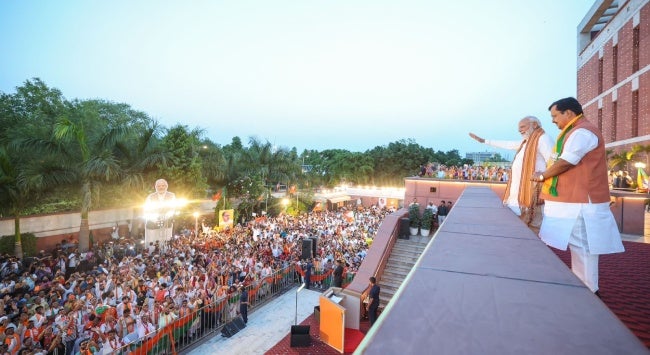
The Bharatiya Janata Party (BJP) achieved a historic victory in West Bengal. This is the first time in nearly 50 years that the ruling party at the centre has come to power in West Bengal. The win was the result of deep anti-incumbency against the Trinamool Congress, Hindu consolidation in favour of the BJP and its promise of transforming the state.
Of the state elections held in April 2026, the result in West Bengal, leaving aside the phenomenal success of film star Joseph Vijay Chandrasekhar in Tamil Nadu, was arguably the most consequential. West Bengal was a prize that the Bharatiya Janata Party (BJP) had been eyeing since 2014 though few had anticipated a landslide victory for the party. The BJP won 207 of the 294 assembly seats and a vote share of 46 per cent, reducing the ruling Trinamool Congress (TMC) to 80 seats and 41 per cent vote share. It was a near reversal of the 2021 election where the BJP won 77 seats and the TMC 215. The historic nature of the BJP’s win in West Bengal can be gauged from the fact that political change in the state occurs at long intervals and that this is the first time in nearly 50 years that the ruling party at the centre has been able to win in West Bengal.
There were several factors behind the BJP’s sweep but the key one was anti-incumbency against the three-term TMC government. The anti-incumbency flowed from several issues, including corruption, both among the party cadre as well as scams involving senior leaders, law and order and the government’s inability to attract industry and generate jobs. Some of these issues were a byproduct of what political scientist Dwaipayan Bhattacharya has called TMC’s ‘franchisee politics’ where local party leaders exerted control, often violently, over their own territories in exchange for fealty to Chief Minister Mamata Banerjee. It was the common people who bore the brunt of the excesses of the local party bosses and very few observers had been able to gauge the extent of resentment against the TMC’s party machinery. The party too was internally divided with some of the old guard and cadre unhappy at the rapid rise of Mamata’s nephew, Abhishek Banerjee, within the party.
Second, the Election Commission’s poorly implemented Special Intensive Revision (SIR) of the electoral roll too played a role though it would not have fundamentally changed the overwhelming mandate in favour of the BJP. Of the nine million names that were deleted, 2.7 million voters, who were struck off the roll due to ‘logical discrepancies’, were placed under adjudication. However, the fate of a majority of these voters was not decided before polling despite the Supreme Court’s intervention. These deletions were disproportionately high in Muslim-heavy constituencies, which usually backed the TMC. The precise impact of the SIR on the electoral outcome is still being debated. One analysis suggests that the SIR – if one takes into account only the voters under adjudication – possibly had an impact on around two dozen closely-contested constituencies. However, if the total deletions are considered, on 105 seats that the BJP won, the number of voters deleted exceeded its margin of victory.
Third, there is evidence that the TMC in 2026 did not have the kind of Muslim support that it usually does. This was starkly evident in districts such as Murshidabad, where Muslims comprise roughly two-thirds of the population. The TMC won 20 of the 22 seats in Murshidabad district in 2021, while in 2026, its tally dropped to nine. There are 32 seats in West Bengal where Muslims comprise over 50 per cent of the population. In 2021, the TMC won all these seats, whereas this time, it garnered 23. The results suggest that the Congress, the Communist Party of India (Marxist) and parties representing Muslim interests, such as the Indian Secular Front and Aam Janata Unnayan Party, ate into the TMC’s Muslim vote.
The BJP was able to capitalise on the manifold weaknesses of the TMC due to its groundwork and meticulous planning over the last five years which has seen the BJP’s vote share jump more than fourfold from 10 per cent in 2016. Initially, the BJP captured the space occupied by the Left parties and its success was confined to certain pockets of West Bengal, including the northern and western regions. However, this time, the BJP won seats across West Bengal and in areas like greater Kolkata, which were considered the TMC’s strongholds. This was largely on the back of unprecedented Hindu consolidation. Anti-Muslim rhetoric and religious polarisation were very visible in the campaign of local BJP leaders like Suvendu Adhikari as well as other campaigners like Assam Chief Minister Himanta Biswa Sarma.
The BJP’s campaign was also far more targeted, drilling down to the electoral booth level, than the earlier elections. Prime Minister Narendra Modi and Home Minister Amit Shah camped in West Bengal for long stretches and held numerous public rallies across the state. However, the campaign was orchestrated well in advance of the poll by a team of senior leaders, including the party’s national general secretary, Sunil Bansal, and central minister and the state’s election in-charge, Bhupender Yadav.
The BJP’s campaign messaging too was vastly different from 2021. Change (Poriborton) and the promise of economic development were key elements as were welfare schemes for women and youth. The BJP’s manifesto promised ₹3,000 (S$49) a month to women, which is double the amount provided by the TMC’s Lakshmir Bhandar scheme. This dented Mamata’s support among women voters, who have been central to her electoral success. The BJP also worked hard to dispel its image as an outsider and hostile to West Bengal’s culture and ethos.
Ultimately, anti-incumbency, Hindu consolidation and the promise of transforming West Bengal resulted in one of the few remaining opposition bastions to crumble. This will have a profound impact on the state as well as be a crucial milestone in the BJP’s relentless march across India.
. . . . .
Dr Ronojoy Sen is a Senior Research Fellow and Research Lead (Politics, Society and Governance) at the Institute of South Asian Studies (ISAS), an autonomous research institute at the National University of Singapore (NUS). He can be contacted at isasrs@nus.edu.sg. The author bears full responsibility for the facts cited and opinions expressed in this paper.
Pic Credit: X
-
 More From :
-
 Tags :
-
 Download PDF