


Summary
The visit of Bangladesh’s Foreign Minister Khalilur Rahman to New Delhi in early April 2026 marked a significant step toward renewed engagement between India and Bangladesh. However, the future of their bilateral relationship will depend on how effectively both sides manage their shared challenges.
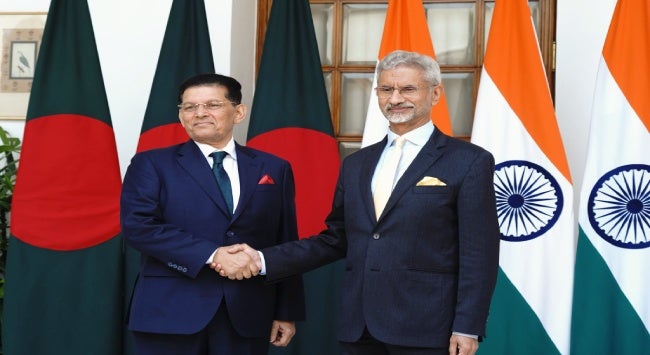
On 7 April 2026, Bangladesh’s Foreign Minister Khalilur Rahman arrived in New Delhi for a two-day visit. This marked the first ministerial visit following the Bangladesh Nationalist Party’s (BNP) return to power. According to Bangladesh’s foreign ministry, the visit was a stopover by the foreign minister on his way to attend the Indian Ocean Conference in Mauritius from 10 to 12 April 2026. Organised annually by India Foundation, an Indian research centre/think tank, since 2016, this year’s conference is being held in collaboration with the Mauritius government.
During the visit to New Delhi, Khalilur Rahman was accompanied by Humaiun Kobir, Foreign Affairs Adviser to the Prime Minister of Bangladesh. The trip came a month after the visit by Major General Kaiser Rashid Chowdhury, Director General of the Directorate General of Forces Intelligence, Bangladesh, who met with India’s Research and Analysis Wing chief, Parag Jain, and Director General of Military Intelligence, Lieutenant General P S Raman.
A day before Khalilur Rahman’s arrival in New Delhi, India’s High Commissioner to Bangladesh, Pranay Verma, paid a courtesy call on Bangladesh’s Prime Minister Tarique Rahman. They “discussed bilateral engagement with focus on people-centric cooperation in multiple domains aligned with the national development priorities of the two countries”. Before arriving in New Delhi, Khalilur Rahman, as quoted in Pratham Alo, stated, “I am going to India before attending the Indian Ocean Conference…We want a normal relationship with India based on mutual respect, dignity and interests.”
In New Delhi, Khalilur Rahman met with India’s External Affairs Minister S Jaishankar, Minister of Petroleum and Natural Gas Hardeep Singh Puri and National Security Adviser Ajit Doval. During the meeting with Jaishankar, the two sides agreed “to explore proposals for deepening the partnership through the relevant bilateral mechanisms”. Bangladesh also made several requests. These included India increasing supplies of diesel and fertiliser due to the situation in the Middle East as well as the extradition of deposed prime minister Sheikh Hasina and former home minister Asaduzzaman Khan Kamal to serve the sentences meted by the International Crimes Tribunal. The two sides also agreed on the extradition of the killers of student leader Sharif Osman Bin Hadi, who were arrested in the Indian state of West Bengal. Jaishankar also stated that Indian visas for Bangladeshis, particularly medical and business visas, would be eased in the coming weeks.
The visit reflected a mutual effort to reset bilateral ties. However, for progress to be effective and sustained, both sides must carefully manage their more contentious issues.
First, the political resolution of Hasina’s extradition is crucial to improved India-Bangladesh ties.
Second, the illegal movement of humans and cattle has often created tensions along the India-Bangladesh border. In a recent case, a Bangladeshi, Ali Hossain, was shot dead by India’s Border Security Force on 7 April 2026, when, along with seven to eight others, he crossed the zero-line and entered into Indian territory.
Third, in 2024, the National Independent Inquiry Commission, set up under Major General (Retired) A L M Fazlur Rahman to investigate the Peellkhana mutiny of 2009, carried out by Bangladesh Rifles, a paramilitary force, in which 74 people, including 57 army officials died, reported that then Member of Parliament Sheikh Fazle Noor Taposh “acted as the principal coordinator” with the “green signal” from Hasina. Fazlur Rahman also pointed to the involvement of external forces in the mutiny and many scholars have argued that India responded to Hasina’s emergency call to suppress the revolt. Political interpretations of the mutiny and allegations, regardless of authenticity, generate popular resentment and disquiet. As historical issues often give rise to friction unless mutually resolved, India and Bangladesh will need to address this past incident directly.
Fourth, the protection of minorities, particularly Hindus, in Bangladesh, is of political concern to India. Just before Bangladesh’s 13th elections, the South Asia Forum for Freedom of Religion or Belief expressed concern over the escalating violence, intimidation and targeted attacks against religious and belief minorities. The condition of Hindu minorities has a spillover effect on various aspects of India-Bangladesh ties, including sports.
Fifth, the foreign policy orientation of Bangladesh’s interim government did not align with India’s regional interests. Tarique Rahman has been vocal about ‘Bangladesh First’ in foreign policy matters. During an election rally in the Nayapaltan area of Dhaka, he declared, “Not Dilli [Delhi], not Pindi [Pakistan Army Headquarters in Rawalpindi], Bangladesh above all”. Khalilur Rahman also conveyed to New Delhi that the BNP government will pursue a ‘Bangladesh First’ policy based on “mutual trust and respect and reciprocal benefit”.
Finally, the renewal of the Ganga/Ganges Waters Treaty on terms acceptable to both sides and a decision on the interim pact on the Teesta Rivers will also likely set the direction for India-Bangladesh relations.
Khalilur Rahman’s visit to India may mark the close of an 18-month period of strained relations. Yet both countries must recalibrate their policies and make concerted efforts to manage – if not resolve – their differences before they escalate into renewed tensions.
. . . . .
Dr Amit Ranjan is a Research Fellow at the Institute of South Asian Studies (ISAS), an autonomous research institute at the National University of Singapore (NUS). He can be contacted at isasar@nus.edu.sg. The author bears full responsibility for the facts cited and opinions expressed in this paper.
Pic Credit: X
-
 More From :
-
 Tags :
-
 Download PDF