


The Paradox of Popular Mobilisation:
Bangladesh’s Gen Z and Electoral Reality
Imran Ahmed
20 March 2026Summary
Why did the Gen Z-led protest movement in Bangladesh not translate its political momentum into electoral success? The answer lies in structural factors particular to Bangladesh, including the dominance of established parties with organisational depth, networks and experience, as well as the referendum, which condensed complex political choices into a single binary question and subsumed new party platforms within a broader yes-or-no decision on reform. At the same time, the ability of established actors to reinvent and rebrand themselves as agents of change meant that while many voters supported reform, they preferred that change be guided by familiar political actors rather than untested alternatives.
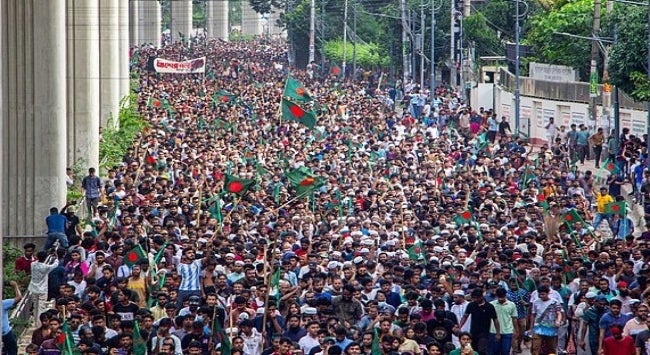
Bangladesh’s Gen Z-led protest movement reshaped the country’s political landscape and placed institutional reform, electoral governance and constitutional change at the centre of national political debate and public discourse. Yet despite the momentum generated by the uprising, youth-led political formations struggled to translate that energy into electoral success. The results of the February 2026 election suggest that while the protests transformed the political agenda, established political actors retained structural advantages within the electoral arena.
Established parties possess long-standing networks, disciplined party structures and well-developed grassroots mobilisation channels. The resurgence of Jamaat-e-Islami illustrates this dynamic. Despite years of marginalisation, the party was able to re-enter the political arena and compete effectively once the political environment shifted. By contrast, newer formations emerging directly from protest mobilisation lacked this comparable institutional depth. The National Citizen’s Party (NCP), formed by leaders associated with the uprising, attempted to transform the legitimacy and symbolism of the protests into a political platform.
However, building durable political organisations capable of contesting elections requires time, organisational infrastructure, and local networks that protest movements often do not immediately possess. This organisational gap posed a significant obstacle for youth-led actors. When the NCP attempted to address this weakness by aligning with Jamaat-e-Islami, the move produced internal tensions, divisions and disillusionment. This weakened its ability to sustain a clear and distinct political identity in an increasingly competitive electoral field.
Secondly, the political landscape after the uprising was also highly fragmented and shaped in part by shifting alliances, the choice of some 51 different political parties and the absence of the Awami League. Moreover, youth-led groups faced competition not only from established parties and their coalitions but also from a large number of independent candidates which further dispersed political competition. This prevented the consolidation of support around any single youth-led movement and diluted the electoral impact of the protest movement’s momentum.
Thirdly, institutional features of the election itself further complicated the situation. The parliamentary election was held alongside a national referendum on constitutional reform. Voters were asked to approve or reject a package of reforms through a simple ‘Yes’ or ‘No’ vote. This design shifted attention away from individual party platforms. Instead of focusing on the minutiae of competing political programmes, the electoral debate increasingly centred on whether voters supported or opposed the broader reform agenda. In this context, the distinct political offerings of newer youth-led actors became somewhat subsumed as the election became less about competing visions from emerging actors and more about which political forces would oversee the reform process.
These dynamics do not necessarily indicate that the Gen Z protests failed. On the contrary, the decision to hold the parliamentary election alongside a national referendum on constitutional reforms reflects the extent to which these issues had moved to the centre of political debate. In this sense, the protests were so successful in redefining the political agenda that they also created opportunities for established parties to instrumentalise that agenda and use it to reinvent themselves. Jamaat-e-Islami again provides a pertinent example. The post-uprising environment allowed the party to shed its image as a controversial and, for many, sinister relic of the old political order, and present itself as a reform-minded alternative to status quo politics.
Finally, while it remains difficult to determine precisely how younger voters behaved electorally, the overall outcome of the election points to a broader pattern in voter preferences. The strong performance of an established party such as the Bangladesh Nationalist Party suggests trust in actors with organisational experience and governing capacity. While support for the referendum indicates that the demand for political change is a central, defining political concern. What this reveals is that voters were not just choosing between change and continuity, but also between competing approaches to managing change.
. . . . .
Dr Imran Ahmed is a Research Fellow at the Institute of South Asian Studies (ISAS), an autonomous research institute at the National University of Singapore (NUS). He can be contacted at iahmed@nus.edu.sg. The author bears full responsibility for the facts cited and opinions expressed in this paper.
Pic- Credit: Wikimedia Commons
-
 More From :
-
 Tags :
-
 Download PDF