


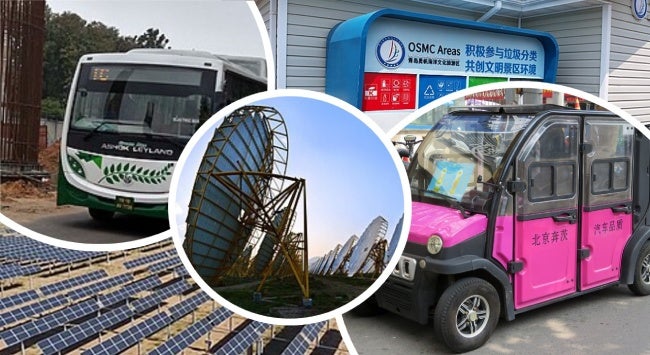
Calibrating India-China Climate Cooperation in 2026
Karthik Nachiappan, Pooja Ramamurthi, Constantino Xavier
24 February 2026Summary
Global climate politics is entering a fragmented and polarised phase. Geopolitical rivalry, fiscal constraints and shifting domestic priorities have weakened collective action, while trust in multilateral processes has eroded even as climate risks intensify. At the same time, the focus has shifted from negotiation to implementation – from setting targets to financing transitions, upgrading infrastructure and managing socio-economic trade-offs. In this context, cooperation is becoming increasingly selective, technical and interest-driven.
For India and China, climate engagement is no longer defined by shared positions at global negotiations. Rather, climate policy is determined by national choices on how both countries manage risk, scale investment and build governance capacity across finance, power systems and adaptation both at home and within structures of global governance. Within this shifting landscape, the scope, limits and possibilities of bilateral climate cooperation must be reassessed. While India-China climate cooperation may benefit from narrowing in scope, it can gain by deepening in function, shifting from symbolic alignment to technical, implementation-focused engagement.
In climate finance, cooperation is not only shaped by economic opportunities but also by geopolitics, regulatory credibility and protectionism. Direct bilateral finance flows remain constrained by trust deficits and restrictive policies, making rule-based engagement – data harmonisation, standards alignment and governance learning – the most realistic pathway for bilateral engagement. Recent signals suggest that the Indian government may be selectively reconsidering Chinese investments in select, non-sensitive sectors. The core constraint, if investment bilateral flows improve, will not be capital scarcity but elevated risk; cooperation that improves predictability, disclosure and enforcement can make green projects bankable. Public finance should prioritise de-risking through guarantees and blended structures, while private capital provides scale. Multilateral and plurilateral channels remain essential to build institutional trust and manage political risk.
The priority will also be interoperability, not integration: aligning taxonomies, reporting and disclosure standards to cut transaction costs and enable cross-border investment. Over time, Indian and Chinese converging green taxonomies can potentially create standards for the Global South, with both countries emerging as norm-shapers.
Climate action has also shifted from setting targets to delivering results, particularly with addressing challenges in implementing renewable capacity, calling for the urgent need to modernise power systems. In India and China, rapid renewable expansion has outpaced grid readiness, regulatory reform and market design, creating similar barriers for effective decarbonisation. The binding constraint is no longer generation but flexibility – storage, demand response, interconnection and operational agility, without which renewables cause less cost-effective, unreliable systems. In both countries, market reform is essential but politically complex, constrained by weak utility finances, long-term contracting structures and subnational political economies that require gradual, context-specific solutions.
Digitalisation is introducing opportunities to improve interoperability, standards and resilience of critical infrastructure, while coal’s structural persistence necessitates a sequenced transition anchored on electrification and flexibility, not abrupt phase-outs. Given that both countries face similar challenges, power system modernisation emerges as a practical, low-risk entry point for cooperation: technical, incremental and execution-focused shared learning in planning, regulation and operations that do not require strategic alignment.
Another critical area of potential India-China climate engagement is urban adaptation. Cities in both countries have dense populations, asset concentration and infrastructure interdependence, resulting in significant socio-economic impacts from disruptive extreme events. Mitigating these negative impacts makes resilience investments vital. Structural differences in urban governance offer complementary strengths: China’s integrated planning and execution capacity and India’s adaptive, locally responsive systems create opportunities for mutual learning, not institutional convergence. The priority is to mainstream adaptation into urban planning through heat action plans, early warning systems, standards-based design and health systems into daily life.
At the same time, both India and China need to scale nature-based and hybrid solutions that link water, buildings and ecosystems to improve the quality of life. Community-level preparedness and social capacity are as critical as physical infrastructure, reinforcing the need to invest in response systems suited for the local context. Financing remains a binding constraint, with blended finance, municipal bonds and green instruments still evolving; aligning resilience standards and metrics offers a practical pathway to shape Global South norms, while city-to-city technical exchanges, practitioner networks and joint assessments provide a low-sensitivity channel for collaboration. Further, the participation of Indian and Chinese cities in groupings such as the C40 Cities provides alternative channels for engagement.
Systemically, multilateral climate governance has become more fragile, with declining trust, leadership and financing accelerated by geopolitical shifts. This context imposes new limits on India-China convergence, unlike earlier periods when multilateral climate platforms enabled consistent engagement. India and China are now pursuing dual strategies beyond the United Nations Framework Convention on Climate Change: preserving and reforming existing regimes while building parallel regional, sectoral and issue-based platforms, from Multilateral Development Bank channels to BRICS-linked initiatives, as complementary governance tracks. While both countries broadly converge on equity, differentiated responsibilities and climate finance, divergences on emissions pathways, technology leadership and rule-making conditions constrain cooperation.
Further, China’s rise as an electro-state, dominating green supply chains globally and India’s growing green trade imbalance have resulted in distinct positions on trade liberalisation. Instances such as China’s World Trade Organization complaint on India’s domestic subsidies through the Production Linked Incentives schemes for electric vehicles, batteries and solar as discriminatory marks this rift. Engagement will likely shift from grand bargains to selective, sector-specific coordination, particularly in adaptation, disaster risk reduction, sectoral decarbonisation and development finance reform. The focus is moving from technology transfer to implementation and governance, with progress potentially feasible on aligning standards, data systems and regulatory practices.
A window exists to recalibrate India-China climate engagement around implementation, institutional coordination and governance rather than symbolism or scale. Across climate finance, power sector reform, urban adaptation and climate diplomacy, cooperation is most viable where it reduces risk, strengthens implementation capacity and aligns standards without requiring strategic trust.
The pathway forward is incremental and domain-specific: coordinating investment rules to mobilise capital, modernising power systems to drive emissions reductions, embedding adaptation in urban governance and shaping global norms through technical coordination. In a fragmented climate order, progress will depend on sustained, low-visibility collaboration that builds confidence while advancing practical outcomes. The priority is to sequence and deepen sector-specific cooperation while maintaining broad institutional channels to support shared climate and energy goals.
This brief is based on discussions at the 2nd India-China Climate Cooperation workshop in Singapore in January 2026.
. . . . .
Dr Karthik Nachiappan is a Research Fellow at the Institute of South Asian Studies (ISAS), an autonomous research institute at the National University of Singapore (NUS). He can be contacted at karthiknach@nus.edu.sg. Dr Pooja Ramamurthi is a Fellow at the Centre for Social and Economic Progress, New Delhi. She can be contacted at pramamurthi@csep.org. Dr Constantino Xavier is a Senior Fellow at the same centre. He can be contacted at cxavier@csep.org. The authors bear full responsibility for the facts cited and opinions expressed in this paper.
Pic Source: Wikimedia Commons
-
 More From :
-
 Tags :
-
 Download PDF