


Summary
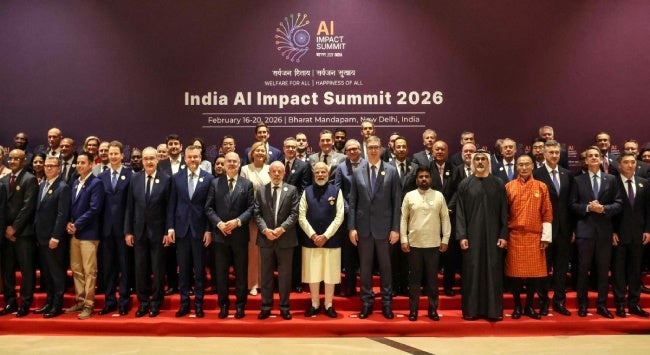
India’s Artificial Intelligence (AI) Impact Summit in February 2026 illustrates how New Delhi is using diplomacy to align development ambitions, technology sovereignty and geoeconomic strategy – reframing global AI governance around access, democratisation and Global South inclusion while deepening strategic supply-chain partnerships.
By convening the February 2026 Artificial Intelligence (AI) Impact Summit in New Delhi and framing it around ‘People, Planet and Progress’, India sought to reposition global AI governance around development outcomes and ‘democratisation’, while simultaneously deepening strategic technology alignments and supply-chain partnerships.
One way to read the Summit is as a diplomatic instrument: a space where the host state translates domestic AI priorities into international narratives, then builds coalitions and partnerships that reinforce those priorities. Seen this way, the Summit reflects India’s attempt to advance specific AI interests – aligning market scale, infrastructure expansion and norm entrepreneurship.
Motivations
The Narendra Modi government’s AI agenda centred on two core objectives. The first was to make AI cooperation ‘impact-oriented’ for social and economic delivery and the second was to ensure that developing countries are not passive recipients of AI rules crafted elsewhere. These themes were embedded in the Summit’s three markers – ‘People, Planet and Progress’ – and in its explicit characterisation as a Global South-driven forum.
The ‘democratisation’ narrative served multiple purposes. It framed AI as a development catalyst rather than primarily a frontier risk problem. The Summit was praised for advancing a human-centric and democratised vision of AI, with references to proposals such as an international scientific panel on AI governance. Modi reiterated his ‘MANAV Vision for AI’, casting technology as an enabler of inclusive growth.
At the same time, democratisation functioned as a hedge against AI rule-making dominated by advanced economies. By foregrounding access to computing, affordability, multilingual inclusion and public-interest use cases, India signalled that governance should not become synonymous with restrictive regulation.
A second pillar – ‘sovereign’ and ‘responsible’ AI – emphasised expanding domestic capacity. Under the IndiaAI Mission, the government has moved to expand national Graphics Processing Unit capacity beyond an existing 38,000 units, adding approximately 20,000 more This expansion was presented as the democratisation of compute: lowering costs, widening access to datasets and supporting public-interest applications.
Reframing Global AI Governance
India sought to shift global AI governance discourse in three ways. The first was to move the conversation from a narrow ‘AI safety’ lens toward development and deployment. Second, the Summit foregrounded South-South cooperation and capacity-building. Discussions emphasised interoperable standards, safety tools adapted to developing economies and cooperation as a technological and economic necessity to prevent the Global South from becoming a passive bystander in the AI race. Third, India focused on coalition-building through targeted strategic bargains. Most prominently, on the margins of the Summit, India joined the United States (US)-led Pax Silica initiative and signed a Joint Statement on the India-US AI Opportunity Partnership. These agreements explicitly linked AI governance to semiconductor supply chains, critical minerals, data centre investment and joint research and development.
Summit Outcomes
The Summit’s main anticipated outcome – a Leaders’ Declaration – is yet to be finalised and released. Nevertheless, several outcomes emerged.
The Summit consolidated India’s claim to be a Global South convenor in AI governance. Discussions focused on practical AI governance tools like testing mechanisms, simulation, interoperable standards and evidence exchange and sought to integrate safety with development rather than treat them as separate domains.
Infrastructure-related investment pledges exceeding US$250 billion (S$S$337.5 billion) and roughly US$20 billion (S$27 billion) in deep-tech venture commitments were announced. While these figures remain pledges rather than binding commitments, they serve as market signals. The expansion of national compute capacity reinforced the image of India as both consumer and producer in the AI ecosystem.
Beyond Pax Silica and India-US AI Opportunity Partnership, the Summit saw the launch of a trilateral initiative among Italy, Kenya, and India to co-design ‘sovereign AI’ diffusion pathways in Africa, linked to a G7-endorsed AI Hub for Sustainable Development with the United Nations’ global development programme. These initiatives situate India within overlapping networks including US-aligned supply-chain security frameworks, European development platforms, and South–South cooperation narratives.
Implications
Strategically, India’s diplomatic rationale appears threefold: function as a Global South convenor; attract investment and infrastructure partnerships for its AI trajectory; shape emerging AI norms around access; multilingual inclusion; and technological sovereignty without committing to a binding global regime.
This strategy is not without risk. The first is the potential of asymmetric dependence. India’s AI sovereignty narrative will inevitably intersect with its continued reliance on foreign-designed chips, cloud infrastructure, foundation models and capital. ‘Sovereign AI’ may, in practice, amount less to autonomy and more to interdependence. Managing this tension will require diversifying partnerships and negotiating from market scale, not rhetoric.
Second is credibility and implementation. Global AI summitry often produces soft instruments and ambitious pledges with uneven follow-through. Without a concrete implementation agenda tied to the Leaders’ Declaration, the Summit risks being remembered more for signalling than delivering.
The third is governance. As India positions itself as a norm entrepreneur, greater attention will fall on its domestic deployment of AI, including issues related to surveillance, exclusion and automated decision-making. Bridging development and rights-based governance will be essential for sustaining diplomatic credibility.
Moving Forward
To consolidate gains, India will benefit from releasing a Leaders’ Declaration with a time-bound implementation roadmap. Equally important will be diversifying strategic dependencies so that supply-chain partnerships enhance autonomy rather than deepen vulnerabilities. The AI Impact Summit reflects India’s attempt to align development aspirations, geoeconomic bargaining and norm entrepreneurship in a rapidly fragmenting technological order. Whether that alignment proves durable will depend less on summitry and more on sustained delivery – at home and abroad.
. . . . .
Dr Karthik Nachiappan is a Research Fellow at the Institute of South Asian Studies (ISAS), an autonomous research institute at the National University of Singapore (NUS). He can be contacted at isaskn@nus.edu.sg. The author bears full responsibility for the facts cited and opinions expressed in this paper.
Pic Credit: X
-
 More From :
-
 Tags :
-
 Download PDF