


Between Continuity and Transformation:
Interpreting Bangladesh’s Election
Imran Ahmed, Muhammad Saad Ul Haque
23 February 2026Summary
Bangladesh’s election on 12 February 2026 returned a familiar dynastic party to power at the very moment voters signalled a demand for structural transformation. The outcome presents a fundamental paradox: can an anti-establishment reform agenda be implemented by the very political order it was meant to disrupt? The resolution of this tension will determine whether this electoral moment marks a genuine shift in institutional governance or merely a strategic recalibration of the status quo under altered political conditions.
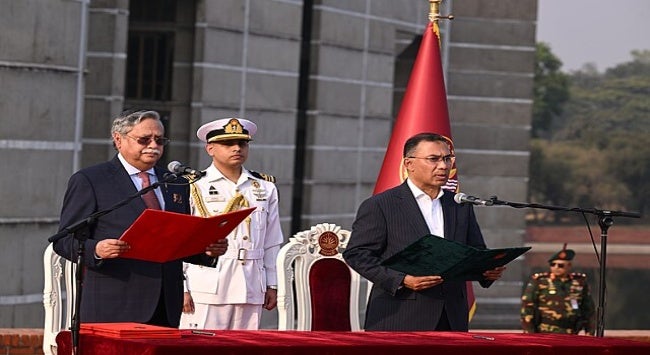
Bangladesh’s general election and constitutional referendum on 12 February 2026 marked a historic moment in the country’s post-2024 political transition. While the Bangladesh Nationalist Party’s (BNP) parliamentary majority heralds a transfer of political authority, the referendum’s approval has shifted expectations for significant governance and institutional reform. What makes this moment striking is that a status quo, dynastic party has been entrusted with carrying forward a programme of transformation that emerged from anti-establishment politics of rupture that defined the July 2024 uprising.
The fact that the vote followed an extended period of political upheaval, shaped not only by the momentum for change generated by the July 2024 uprising but also by the reform process led by the interim administration and the exclusion of the Awami League from electoral participation, is central to understanding its significance. In this regard, the election functioned less as a routine contest and more as a moment that cut through the shifting alliances and political drama to reveal how political reorganisation was actually taking shape on the ground. Indeed, the electorate’s choice reflects a shift from the politics of resistance that characterised the post-uprising moment towards expectation of administrative delivery and institutional consolidation.
At the same time, the referendum outcome places the incoming government under direct obligation to implement institutional reforms outlined during the transition. Designed to lay the foundations for a renewed social contract, the referendum’s ‘Yes’ vote projects public expectation and appetite for an institutional overhaul, but its realisation will hinge on the political will needed to carry through reforms. The political will, in this context, is not a starting condition but rather a product of sustained pressure, incentives and legitimacy risks to the new government to overcome institutional inertia. The success of the reform process will then depend less on constitutional design alone and more on maintaining consensus, public accountability, administrative capacity and the credibility of state institutions to translate reform commitments into practice.
Questions of representation also complicate the narrative of democratic renewal. Only seven women won directly elected seats in the election and only a small number of representatives from religious and ethnic minority communities entered parliament. While the reserved-seat system will increase women’s formal representation, the weak performance of women and minority candidates in direct elections reveals the enduring obstacles that constrain substantive political inclusion. The election, in other words, highlights the persistence of structural inequalities within the political field. This sits uneasily with Bangladesh’s long history of women occupying the highest political office – indicating the gap between elite leadership and broader patterns of political representation.
Moreover, the BNP’s electoral mandate, while clear, remains socially and politically conditional. While the scale of the victory is significant, legitimacy will depend more on how the new government responds to longstanding concerns that shape public trust. Ongoing anxieties around minority protection, corruption and political violence mean that many voters are assessing whether this transition represents genuine change or simply a shift in political actors. For the younger voters in particular, shaped by the politics of protest, the central question is whether entrenched patterns of patronage and confrontation will re-emerge under a different leadership. In this sense, the BNP has secured power but not yet trust, and how it governs will determine whether the current moment is understood as a break from the past or a continuation of familiar political cycles.
More broadly, the election reflects a restructuring of Bangladesh’s party system. The traditional BNP-Awami League binary has been disrupted by the latter’s exclusion and by the emergence of new political actors. A more fragmented configuration is now taking place: a dominant nationalist governing party, a religious-conservative bloc with growing electoral influence, youth-driven political formations seeking institutional space and a socially embedded but politically constrained Awami League constituency. The election did not just change who governs, it also reflected a reconfigured political landscape in which the organisation and dynamics of political competition have fundamentally shifted.
Finally, the election reshapes Bangladesh’s external environment, recalibrating how India, Pakistan, China and the United States (US) engage with Dhaka. Each relationship carries its own historical baggage, strategic expectations and geopolitical calculations. Relations with India remain influenced by political frictions surrounding Sheikh Hasina’s exile and concerns in New Delhi over minority protection. Pakistan, by contrast, has moved to re-engage diplomatically and economically, signalling openness to expanded cooperation under the new political configuration. China’s role is likely to remain pivotal, given its entrenched economic footprint across infrastructure, trade and investment. The US, meanwhile, is expected to pursue a pragmatic – if at times transactional – approach focused on trade, governance and regional security. The new government in Dhaka, therefore, inherits not a blank slate but a dense web of dependencies, tensions, and opportunities that will constrain and define its strategic options. In this context, foreign policy becomes less an exercise of choice and more a balancing act among competing external pressures.
. . . . .
Dr Imran Ahmed is a Research Fellow at the Institute of South Asian Studies (ISAS), an autonomous research institute at the National University of Singapore (NUS). He can be contacted at iahmed@nus.edu.sg. Mr Muhammad Saad Ul Haque is a former Research Analyst at the same institute. He can be contacted at msaaduh@gmail.com. The authors bear full responsibility for the facts cited and opinions expressed in this paper.
Pic Credit: Wikimedia Commons
-
 More From :
-
 Tags :
-
 Download PDF