


Structural Ties, Political Change:
Bangladesh, China and the Next Government
Imran Ahmed, Mriganika Singh Tanwar
11 February 2026Summary
China’s growing economic and political presence in Bangladesh is embedded in the country’s infrastructure, investment patterns and political relationships rather than limited to individual projects or governments. The post-election government’s defining task will be to manage that dependence in a way that preserves autonomy rather than locking the country into asymmetric reliance.
Recent outreach by Chinese Ambassador to Bangladesh Yao Wen to the leaders of the Bangladesh Nationalist Party (BNP) and Jamaat-e-Islami signals a shift in how Beijing is positioning itself within Bangladesh’s changing political landscape. Rather than engaging only with the government of the day, China is building relationships across party lines as Dhaka navigates a turbulent post-Sheikh Hasina transition. As Bangladesh rebuilds amid electoral uncertainty, Beijing appears intent on ensuring that its role remains a constant regardless of who forms the next government.
Bangladesh and China have steadily deepened their engagement over the decades. This culminated in the elevation of bilateral ties to a strategic partnership during Chinese President Xi Jinping’s visit to Dhaka in 2016. In July 2024, the Hasina government further expanded this relationship through a Comprehensive Strategic Cooperation Partnership centred on Belt and Road Initiative (BRI) projects, infrastructure and trade. This reinforced China’s position as a central development partner just as Bangladesh entered a period of political upheaval.
The Muhammad Yunus-led interim government has largely maintained continuity in Bangladesh’s engagement with Beijing. During a recent visit to China, Xi and Yunus agreed to initiate negotiations on a free trade agreement and an investment agreement, potentially expanding Chinese private investment and manufacturing activity in Bangladesh. Xi also reaffirmed zero-tariff access for a range of Bangladeshi exports until 2028, while Dhaka sought Chinese support on the Rohingya refugee situation and concessions related to loan interest rates and commitment fees. Both sides signalled their willingness to sustain cooperation on flagship projects such as the Teesta River initiative, new multi-role combat aircraft for the Bangladesh military and multimodal connectivity linking Kunming to Bangladeshi ports.
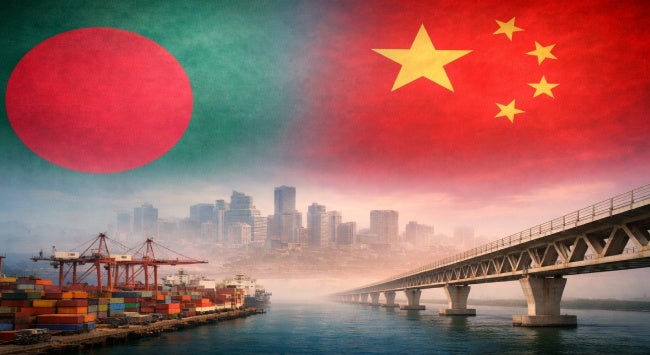
For Beijing, Bangladesh is a significant partner for three interconnected reasons: connectivity, production and politics. First, Bangladesh is a key BRI node, and Dhaka has framed BRI as central to promoting the country’s socio-economic development. Chinese finance and firms have undertaken large infrastructure projects such as the Bangabandhu Sheikh Mujibur Rahman Tunnel under the Karnaphuli river, the Padma Bridge, the Payra coal power plant, the Dasherkandi sewage treatment plant and the Info-Sarkar ICT project. Almost 90 per cent of upcoming energy projects are led by Chinese investors. This highlights Beijing’s central role in Bangladesh’s energy transition.
Second, Bangladesh has become an important outlet for Chinese industries seeking cheaper labour and land while staying within China-linked supply chains. Between 2015 and 2025, Chinese public and private investors committed over US$ 30.13 billion (S$38.3 billion) to Bangladesh. By 2022, China had become the country’s largest source of foreign direct investment with US$ 940 million (S$1.19 billion). This aligns with Beijing’s strategy of offshoring labour-intensive production while retaining higher-value segments of manufacturing within its own networks. For Dhaka, the inflows are attractive, but they come with risk of high reliance on a single partner.
Third, China now treats Bangladesh as a political asset in South Asia, where India has traditionally held influence. In a joint press release between the Yunus and Xi governments, China reciprocated the support by stating, “[China] respects the development path independently chosen by the people of Bangladesh, and supports Bangladesh in exploring a development path suited to its own national conditions.” This rhetoric reassures Dhaka but also allows Beijing to frame its expanding role as a neutral actor, even as its economic grip grows.
China’s engagement with Bangladesh during the post-Hasina transition increasingly reflects a broadening from traditional state-to-state diplomacy to sustained outreach across the political spectrum. This signals an effort to preserve continuity in bilateral ties regardless of electoral outcomes. Meetings between Yao Wen and leaders of the BNP during the protest period, alongside engagement with Jamaat-e-Islami figures and party delegations visiting China, point to a strategy of relationship-building that anticipates political change. This approach also enables Beijing to frame its engagement as consistent and non-partisan, even as it works to safeguard core interests linked to infrastructure, investment, and strategic access.
This puts Dhaka in a precarious position of balancing between negotiating terms with Beijing without destabilising its own economic recovery. Chinese investments and loans now underpin critical infrastructure and energy projects, creating dependencies that cannot be easily unwound even if a new leadership wished to diversify partners after the February 2026 election. Any attempt to renegotiate terms or recalibrate exposure will have to contend with looming debt obligations, the need for continued investment, and the risk of signalling instability to other external partners. Yet Dhaka is not without agency. The very fact that Beijing is courting multiple political actors suggests China expects Bangladesh to remain strategically relevant to its BRI projects and enable it to exercise regional influence in South Asia.
The 2026 election will be a decisive factor for Bangladesh-China relations. Dhaka needs a government that could turn the economic dependence on China into bargaining power by insisting on more transparent terms, prioritising diversification in critical value chains, and coordinating closely with other regional partners. If Bangladesh’s next government relies too easily on Chinese funding because it is fast, available and politically convenient, it may solve short-term development needs but create long-term dependency that limits policy freedom. As the country stands at a critical juncture, the real test is whether its new rulers can craft a relationship with Beijing that supports nation-building without mortgaging autonomy.
. . . . .
Dr Imran Ahmed is a Research Fellow at the Institute of South Asian Studies (ISAS), an autonomous research institute at the National University of Singapore (NUS). He can be contacted at iahmed@nus.edu.sg. Ms Mriganika Singh Tanwar is a Research Analyst at the same institute. She can be contacted at m.tanwar@nus.edu.sg. The authors bear full responsibility for the facts cited and opinions expressed in this paper.
Pic Credit: Chatgpt
-
 More From :
-
 Tags :
-
 Download PDF