


Summary
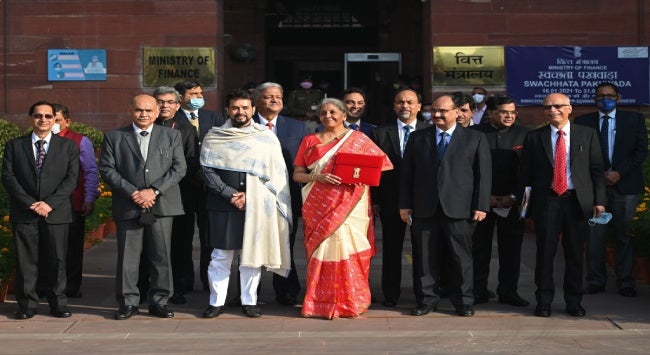
The Indian Budget 2026-27, presented on 1 February 2026, can be seen as a fiscally prudent and strategically forward-looking roadmap for India’s macroeconomic trajectory as it preserves fiscal discipline, accelerates infrastructure investments and introduces tax simplification and targeted incentives designed to boost competitiveness and investment.
The Indian budget presentation, an annual exercise, comes with its usual media attention. However, considering the quantum of committed expenditure and the competing demands on every rupee spent by the government, the flexibility available to the finance minister is very limited. Added to the financial constraints are the political compulsions at times due to impending elections in certain states. However, it must be granted, to the credit of the government, that in recent years, it has managed to abjure political freebies and stayed on the path of maintaining fiscal discipline and stability in the face of global challenges.
As a consequence, the economy enters FY2026-27 with relatively strong macro foundations: with gross domestic product (GDP) growth estimated at around 7.4 per cent, one of the highest among major economies. The fiscal deficit, set at 4.3 per cent of GDP, continues a multi-year effort to slowly reduce deficit levels from pandemic highs. Central government debt stands at around 55.6 per cent of GDP. Public investment (capex) is significantly elevated, with ₹12.2 trillion (S$19 billion) allocated, reflecting a continued shift to infrastructure-led growth. This approach portends fiscal prudence with growth-orientation, balancing investment with sustainability. This policy is widely believed to be essential in a global environment of uneven recovery and geopolitical stress.
The budget’s fiscal strategy emphasises consolidation over short-term stimulus. Reducing the deficit and containing debt are central themes, reflecting a desire to keep inflation pressures in check and maintain investor confidence, especially as global central banks grapple with inflationary legacies and tight monetary conditions.
Tax Reforms and Simplification
The government has proposed certain structural tax reforms intended to simplify compliance and boost India’s competitiveness. A new Income Tax Bill consolidates and simplifies provisions, cutting sections and explanations while improving clarity in language and structure. Rationalisation of customs duties and targeted exemptions for strategic sectors like nuclear, aviation and data services form part of the tax strategy. These reforms are intended to reduce compliance burdens and are designed to attract investment, both domestic and foreign, in key industries.
The government has focused on a significant long-term tax incentive regime for cloud and data infrastructure, by announcing a tax holiday through 2047 for foreign companies providing global cloud services using Indian data centres. This means foreign cloud providers (such as AWS, Microsoft Azure and Google Cloud) that host their infrastructure in India and serve global clients could be exempt from certain taxes on income from those services for two decades. These incentives are strategic, not merely fiscal, and they signal India’s intent to become a global digital hub for cloud computing and data infrastructure. Local data-centre build-out could lower latencies and costs for domestic users, spur jobs in high-value tech services and support artificial intelligence (AI) and big-compute sectors. Such a provision has its own challenges as data centres are capital and energy-intensive. Its success hinges on complementary policy action, especially in infrastructure (power, fibre, cooling capacity), regulatory reform and skill development to fully leverage cloud and AI opportunities.
The budget also deepened India’s commitment to semiconductor manufacturing and the electronics ecosystem by launching India Semiconductor Mission 2.0 (ISM 2.0) with a significant outlay, aiming to accelerate domestic chip manufacturing capacity and reduce import dependence. India’s earlier semiconductor incentives have been expanded and multiple projects with large investment potential are underway. The global chip shortage and geopolitics have underscored the importance of diversified manufacturing. ISM 2.0 is meant to position India as part of this global ecosystem rather than merely a buyer. Considering that semiconductor manufacturing is capital-intensive, the semiconductor push is a bold structural bet. If executed well, it can transform India’s role in global technology supply chains. Success relies on ecosystem development, powerful upstream suppliers, skills, infrastructure financing and global tie-ups.
Structural Challenges
While the budget has made attempts to remedy certain functional issues, there are numerous challenges. India’s major challenge is employment opportunities and job creation. While GDP growth remains robust, employment generation continues to lag in key sectors. Surveys suggest that unemployment and skill mismatches are prominent worries among businesses and the workforce, particularly in labour-intensive sectors. For a young and growing labour force, insufficient job creation could pose socio-economic challenges, especially as demographic dividend expectations rise.
Another major concern is the tax weak buoyancy. If tax collections lag expectations, governments may face a fiscal squeeze, limiting policy flexibility. Recent analyses suggest actual tax buoyancy has underperformed compared to assumptions used in budget forecasting. This has been evidenced by the fact that the government has managed to meet its fiscal deficit target fixed at 4.4 per cent of GDP in FY2026, by reducing capex and helped by higher non-tax revenue collections as against lower tax revenues. The tax collection has been only ₹26.7 trillion (S$41.5 billion) as against the budgeted ₹28.4 trillion (S$44 billion).
It appears that health spending has received notable emphasis, with the Ministry of Health and Family Welfare receiving about ₹1.06 trillion (S$1.65 billion), marking one of the largest allocations to date and almost a 10 per cent increase year-on-year. There is explicit mention of expanding emergency care, mental health institutes, research capacity and access to affordable medicines. Indeed, crossing a provision of ₹1 trillion (approximately S$1.56 billion) is symbolic and sends the right signal about prioritising health since India’s health spend as a share of GDP has historically been low compared to global peers. Similarly, education has also received an eight per cent increase in allocation. While this sector continues to be fairly underprovided for, there is a strategic emphasis in proposing girls’ hostels in every district, industry-linked education-employment committees, new institutes, expansions in technical/science infrastructure and vocational/entrepreneurship linkages.
As India charts its path towards ambitious goals such as a ₹550 trillion (S$9 trillion) economy by 2030, addressing these deeper structural constraints while maintaining macro stability will be critical to translating headline growth figures into inclusive, durable prosperity.
. . . . .
Mr Vinod Rai is an Honorary Senior Fellow at the Institute of South Asian Studies (ISAS), an autonomous research institute at the National University of Singapore (NUS). He is also a former Comptroller and Auditor General of India. He can be contacted at raivinod@hotmail.com. The author bears full responsibility for the facts cited and opinions expressed in this paper.
Pic Credit: X
-
 More From :
-
 Tags :
-
 Download PDF