


Summary
In the aftermath of the youth protest in Nepal in September 2025, significant changes have occurred in Nepal’s political landscape. Although there have been changes in almost all the political parties, they have been significant in some and appear as continuity of the past in the others. How these have been perceived by the Nepali people will be clear after the upcoming general elections.
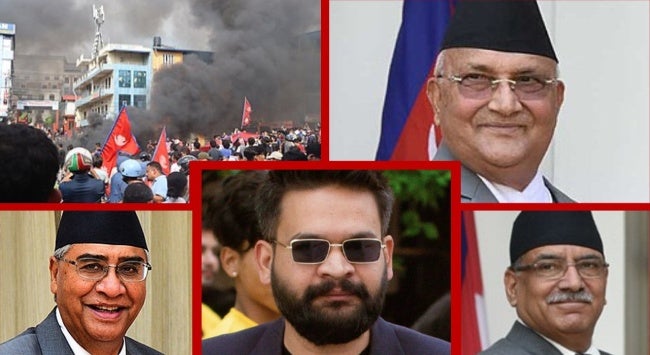
Self-organising themselves and taking to the streets on 8 September 2025, Nepal’s youth expressed outrage against political collusions, corruption, nepotism and bad governance. They demanded change. At the centre of their demand for change, also expressed by the Nepali public at large for a long time, was the retirement of topmost leaders from all the political parties that had entrenched their positions as power centres through all means. Those targeted were Sher Bahadur Deuba of the Nepali Congress, K P Sharma Oli of Communist Party of Nepal (United Marxist Leninist) [CPN (UML)] and Pushpa Kamal Dahal ‘Prachanda’ of the CPN (Maoist Centre).
Political power wielded by these leaders and supported by their cronies had made the task of replacing these senior leaders extremely difficult. However, the turn of events last September, including physical assaults and violence targeted towards them, provided hope that they might have learnt hard lessons and, hence, would renounce their power and positions. Alternatively, it was expected that they might be forced by other leaders within their parties to retire from active politics.
A metric to assess whether the youth protest in Nepal succeeded in instigating a positive change in Nepal’s politics is the position and roles of these three leaders in their parties in the aftermath of the protests. While Prachanda and Oli have retained their power and position, Deuba has been on the losing end because of an unprecedented intervention by youth leaders and party cadres.
Soon after the protests, Prachanda was asked to resign by his Deputy General Secretary Janardan Sharma. However, as a result of his inability to mobilise enough leaders to challenge Prachanda, Sharma himself was sidelined, and he resigned and joined another party. In an attempt to signal change, Prachanda dissolved the central committee, announcing that he was stepping down as party chair while assuming the role of coordinator. Later, nine smaller communist parties merged with the CPN (Maoist Centre) and formed the Nepali Communist Party with Prachanda still at the helm.
In the CPN (UML), several leaders suggested Oli stepping aside in the changed circumstances but he did not budge. He convinced his close aides and the majority of the leaders that his leadership was more crucial in the country’s volatile political environment. When he could muster enough support, Oli called for the party’s general convention and was re-elected as the chair. He was challenged by the Senior Vice Chair of his party, Ishwar Pokharel, who himself is above 70 years of age, and several other leaders in the party. This group had the support of the country’s former president, Bidhya Devi Bhandari, who had created a stir in Nepal by attempting to rejoin party politics after her retirement as the president. Oli not only returned as the chair of his party but also got a large number of his close aides elected to the central committee. He was able to do this following due process, albeit allegedly using unfair tactics. For Nepalese expecting a change in leadership, this was not welcome.
Unlike these two cases, there has been a historic change in the Nepali Congress Party, although not through a usual course, and it has received widespread appreciation. Leaders and party cadres other than those from the Deuba faction had demanded that the party’s general convention be held before the country’s general election so that they could face the people conveying a message of change. Fifty-four per cent of the convention representatives had also demanded organising the special convention if the regular convention was not possible. According to the Nepali Congress party statute, it is mandatory to hold the special convention within 90 days of officially registering the demand for it by at least 40 per cent of the representatives.
However, with the intent of exercising power in selecting the candidates for the election and, once again, becoming the country’s prime minister through alleged coalition with the CPN (UML), Deuba refused to hold either convention under different pretexts. Hence, the party’s two young general secretaries, with the support of the convention representatives, organised the special convention and brought a historic change in party leadership and its policies. The Deuba faction and others in the Election Commission challenged this but the Commission provided legitimacy to the new leadership and committee, entitling them the party’s name, flag and symbol. With this decision being challenged in the court by the Deuba faction, the dispute remains unresolved. However, such a bold intervention by the party’s young leaders and cadres to overhaul the party has received widespread appreciation.
With this change in the Nepali Congress, it appears that the two main contenders in the general elections scheduled for 5 March 2026 will be the Nepali Congress and the Rastriya Swatantra Party (RSP). If public reactions on social media are any indication, there is a growing sense of euphoria around the RSP, particularly after Kathmandu’s independently elected mayor, Balen Shah, who has a huge youth following, joined the RSP.
However, there are also people who do not see the RSP as a formidable alternative political force because of the controversies that the RSP’s chair, Rabi Lamichhane, is embroiled in, Balen’s shocking actions and the party’s populist rhetoric. Perhaps the change in the Nepali Congress has provided them with an alternative.
. . . . .
Dr Puspa Sharma is a Senior Research Fellow at the Institute of South Asian Studies (ISAS), an autonomous research institute in the National University of Singapore (NUS). He can be contacted at puspa.sh@nus.edu.sg. The author bears full responsibility for the facts cited and opinions expressed in this paper.
Pic Credit: ISAS-NUS and Wikimedia Commons
-
 More From :
-
 Tags :
-
 Download PDF