


India’s BRICS Chairmanship in 2026:
Leadership in Times of Global Uncertainty
Amit Ranjan
19 January 2026Summary
As the BRICS chair in 2026, India bears a significant responsibility to demonstrate leadership in navigating an increasingly uncertain global political environment.
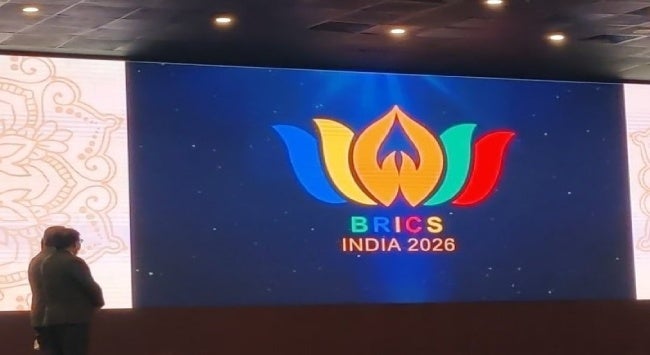
Amidst a tense global political environment, India, as Chair for the BRICS (Brazil, Russia, India, China and South Africa) 2026, has begun preparation to host the grouping’s 18th Summit later this year. On 13 January 2026, Indian External Affairs Minister S Jaishankar unveiled the logo and theme of India’s BRICS chairmanship. The logo “symbolises inclusivity, dialogue and shared growth”. The theme, “Building for Resilience, Innovation, Cooperation and Sustainability”, reflects a people-centric and humanity-first approach articulated by India’s Prime Minister Narendra Modi at the 2025 BRICS Summit in Brazil.
The expanded BRICS Plus accounts for around 37.3 per cent of the world’s gross domestic product and around 54 per cent of the total world’s population. In terms of military capability, it had more than 18 million military personnel in 2023. The Western world, particularly the G7 countries (the United States [US], Japan, Canada, France, Germany, the United Kingdom [UK] and Italy) have significant technological advantage. However, the countries outside the G7 are now producing low-cost defence technologies with high strategic military importance, such as drones.
As India assumes the chairmanship of the BRICS, it is confronted with several key challenges. The member countries have different positions on various global political issues. Differences between the BRICS members are palpable in political developments in Iran, which joined the grouping in 2024. In Iran, there are serious and deadly protests against the country’s Islamic regime. US President Donald Trump has extended support to the protestors and is weighing military options. Trump has also announced that the US will impose a 25-per cent tariff on any country doing business with Iran.
On the Iranian situation, China and Russia have opposed any form of external interference, while Brazil and South Africa have called on Iran to address the situation. Iran was asked to withdraw from the BRICS Plus maritime exercise, ‘Will for Peace 2026’, held at the Port of Simon’s Town, South Africa, from 9 to 16 January 2026. Iran sent three ships to participate in the exercise. However, at the last minute, South Africa asked it to withdraw from the drill. The South African move is widely seen as an attempt to obtain concessions from Trump in the wake of his threat to impose a 25-per cent tariff on countries doing business with Iran. Brazil, Egypt, Indonesia and Ethiopia sent observers while India stayed out of it.
There are also serious unresolved disputes among the BRICS’ members, including between founding members India and China, as well as between newer members Ethiopia and Egypt. Although India and China have made efforts to stabilise and reset their relationship, longstanding territorial disagreements continue to flare up intermittently. A delegation of the Communist Party of China (CPC), led by Vice-Minister of the CPC’s International Department, Sun Haiyan, visited India in January 2026, where it met senior leaders of the Bharatiya Janata Party and Rashtriya Swayamsevak Sangh General Secretary Dattatreya Hosabale. Sun also met Indian Foreign Secretary Vikram Misri.
Simultaneously, India and China are involved in a diplomatic exchange of words over the Chinese infrastructure building in the Shaksgam Valley. The valley became a part of China as a result of an agreement with Pakistan in 1963. India maintained that it has never recognised the China-Pakistan agreement as well as the China-Pakistan Economic Corridor, which passes through Pakistan administered Kashmir region, which New Delhi calls an illegally occupied territory by Pakistan. On the contrary, Beijing stated that the Shaksgam Valley belongs to China and it is justified to carry out construction work in its territory.
Egypt and Ethiopia have disputes over the Grand Ethiopian Renaissance Dam (GERD). Egypt is concerned that the GERD will pose a water threat to the country, while Ethiopia sees it as an essential project for its development and energy security. The two African countries also have differences on Somalia and Somaliland. While Ethiopia treats Somaliland as a distinct political entity, it does not recognise it as a sovereign country. On its part, Egypt signed a defence agreement with Somalia, supporting its political unity and integrity and condemning any attempt to “impose” or “create” any new political formation.
Besides trying to build some form of consensus between the member countries on important global political issues, India has to use its chairmanship to pursue, what Jaishankar said during an event to unveil the BRICS’ logo and theme, “…a reinvigorated, inclusive and effective multilateral order” and make the BRICS commit “…to a reformed multilateralism”. India took over the BRICS presidency from Brazil, under whose tenure there were several important outcomes, including the ‘Rio Declaration to Strengthen Global South Cooperation for a More Inclusive and Sustainable Governance’, the ‘Framework Declaration on Climate Finance’ and a united statement on the global governance of artificial intelligence. India is expected to carry forward the baton in these areas.
Against the backdrop of an increasingly strained global political environment, statements and initiatives emanating from the BRICS Summit in New Delhi this year will carry significant weight in influencing the direction of global politics. Yet the grouping’s ability to exercise such influence depends on its success in reconciling – or at least managing – deep political divergences among certain member countries.
. . . . .
Dr Amit Ranjan is a Research Fellow at the Institute of South Asian Studies (ISAS), an autonomous research institute at the National University of Singapore (NUS). He can be contacted at isasar@nus.edu.sg. The author bears full responsibility for the facts cited and opinions expressed in this paper.
Pic Credit: X
-
 More From :
-
 Tags :
-
 Download PDF