

Nepal and the Universal Periodic Review:
Between Commitments and Consequences
Harsh Mahaseth
15 January 2026Summary
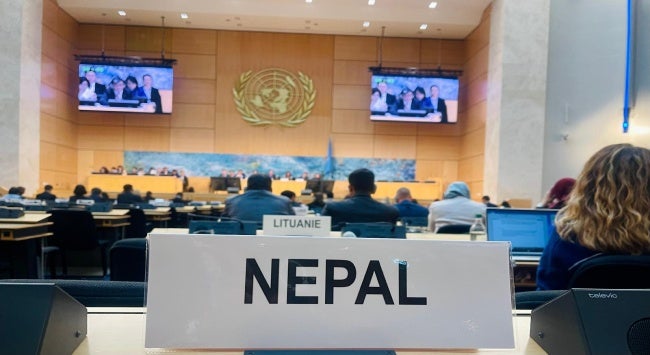
In December 2025, Nepal presented its third cycle of the Universal Periodic Review (UPR) before the United Nations Human Rights Council, projecting substantial compliance with the recommendations it accepted in 2022. The government highlighted progress in strengthening the National Human Rights Commission, advancing the criminalisation of torture, addressing discrimination and improving civil and birth registration systems. Yet this narrative has been sharply contested by civil society and human rights defenders, who point to persistent gaps between commitments and practice. As Nepal approaches its fourth cycle of the UPR review in January 2026, these tensions raise wider questions about performative compliance and the limits of international human rights accountability.
Introduction
Nepal’s engagement with the United Nations (UN) Universal Periodic Review (UPR) has long been presented as evidence of its commitment to international human rights norms. Across successive cycles, Nepal has consistently accepted a high proportion of recommendations and positioned itself as a cooperative participant in the UPR process. Yet acceptance has rarely translated into meaningful implementation. Instead, compliance is often expressed through legislative drafts, procedural assurances and selective reporting, which shows the appearance of reform without its substance.
The third cycle of the UPR review, submitted in December 2025, continued this pattern.[1] Nepal cited progress in strengthening the independence of the National Human Rights Commission (NHRC), advancing the criminalisation of torture, addressing discrimination, and improving civil and birth registration systems. On paper, these measures suggest gradual alignment with international obligations. In practice, however, human rights defenders and civil society organisations contest this narrative, highlighting half-implemented reforms, delays in legislation and the lack of effective accountability mechanisms.
This divergence between commitment and implementation is not new. Over time, a culture of performative compliance has been seen, where the formal acceptance of recommendations substitutes for genuine reform. This has become entrenched in Nepal’s UPR engagements. This entrenched culture of performative compliance reflects not only administrative inertia but also the complex politics of domestic accountability. Many of the reforms accepted in the UPR implicate powerful state actors or require sustained political will, which is often lacking in a fragmented or coalition-based government. Moreover, compliance on paper allows Nepal to maintain an international image of cooperation while avoiding contentious reforms that may provoke political backlash at home. The repeated cycle of formal acceptance followed by delayed implementation raises fundamental questions about the efficacy of international human rights monitoring because it is unclear whether mechanisms like the UPR are encouraging genuine reform or inadvertently rewarding symbolic gestures that leave structural problems unaddressed. This tension highlights the challenge for both states and the international community in distinguishing between genuine commitment and performative alignment with norms.
As the country approaches its fourth cycle of the UPR review in January 2026, these persistent gaps raise critical questions: can international human rights monitoring move beyond symbolic compliance, and will the next cycle serve as a genuine test of Nepal’s accountability, or merely a reiteration of unfulfilled promises?
Performative Compliance in Practice
Nepal’s pattern of performative compliance manifests across multiple sectors, where formal commitments often replace meaningful reform. Legislative assurances, draft policies and selective reporting create the appearance of progress while structural change remains incomplete. The following cases illustrate how these gaps play out in practice.
National Human Rights Commission
The NHRC provides a clear example of this dynamic. The official report from the government details the measures implemented to safeguard the independence of the NHRC and to retain its ‘A’ status under the Paris Principles. However, the amendment to the NHRC Act, which was highly anticipated, is still at the very early stage of inter-ministerial review due to unresolved issues of staff management and financial independence.[2] Nepal gave similar assurances during the last review cycle.[3] The repetition itself is instructive. Institutional reform has always been delayed and never fully accomplished.
The persistent delays in the NHRC reform suggest that formal compliance has become an end in itself rather than a means of strengthening accountability. Without true independence and sufficient resources, the NHRC’s capacity to investigate violations or challenge executive action remains limited. This undermines public trust in institutions designed to safeguard human rights and creates a vicious cycle: international observers see formal steps taken but citizens experience little improvement in practice. In effect, performative compliance masks weaknesses in governance while preserving the appearance of adherence to international norms.
Torture and Custodial Deaths
The government has consistently accepted recommendations to criminalise torture and investigate custodial deaths but implementation remains stalled. Nepal has consistently accepted the UPR’s recommendations that call for making torture illegal and conducting thorough investigations into custodial deaths. However, the country has not yet operationalised an independent investigation mechanism as mandated by the Supreme Court.[4] The Penal Code is also still inadequate to satisfy international standards. Amnesty International Nepal and Advocacy Forum have urged the government to not only adopt legal standards aligned with the UN Convention Against Torture but also to establish an independent body to investigate abuses, a proposal not yet realised.[5] Numerous custodial deaths are still being recorded, and complaints are only made in response to persistent pressure from civil society and the families of the victims. However, there are still no prosecutions. Here, compliance exists on paper but collapses at the point where accountability would require confronting state agents.
This pattern reflects the broader challenge of holding state actors accountable in contexts where entrenched bureaucracies and political networks protect impunity. Legal reform alone cannot alter institutional cultures that tolerate abuse; implementation requires active enforcement and political courage. The failure to operationalise an independent investigative mechanism perpetuates a system where violations are tolerated and normalised, sending a message that human rights obligations are subordinate to administrative convenience. Over time, this weakens public faith in both domestic institutions and international oversight, reducing the effectiveness of future UPR cycles and diminishing the normative power of human rights frameworks in Nepal.
Media Freedom
Legal guarantees for freedom of expression exist, yet new legislation and enforcement practices continue to restrict these rights, with particularly severe consequences for female journalists.
There is an even more glaring contradiction between media freedom and freedom of expression. The right to communication and freedom of expression are guaranteed by the Constitution of Nepal. However, in reality, regulations like the Electronic Transactions Act (ETA) and new legislation like the Media Council Bill and the Social Media Bill are rapidly restricting these rights. Section 47 of the ETA violates Article 19 of the International Covenant on Civil and Political Rights in terms of legality and specificity as it criminalises content that is regarded as being against “public morality”. Regardless of ultimate acquittals, its frequent use against journalists, activists, and social media users has had a chilling effect.
During the third cycle of the UPR review, Nepal supported recommendations from Brazil, Canada, and the United States to revise legislation restricting freedom of expression. However, Section 47 is still in place, and any changes run the danger of increasing rather than decreasing executive discretion. The nationwide TikTok ban between November 2023 and August 2024 exemplified this approach.[6] It was brutal, excessive and supported by public order narratives devoid of evidence-based evaluation.
These legal reforms are going on simultaneously with a decrease in journalists’ safety. In the 2025 World Press Freedom Index, Nepal slipped 16 places to become the 90th country in the world.[7] A total of 257 violations of press freedom, including journalists being threatened or attacked, were recorded between 2023 and 2025.[8] Impunity has continued to be the norm despite Nepal agreeing to the UPR recommendations from Estonia, France, Greece and Iceland to protect journalists and investigate abuses. Arrests occur swiftly when demonstrators or critics are involved; however, investigations take longer when state actors are involved.
For female journalists, the expected challenges are even more profound. From having to work in hostile environments, going through online harassment, getting unequal pay and being denied maternity benefits, many people have left the profession entirely. The joint UPR submission made by Media Action Nepal and Article 19 reveals the fact that gender-based discrimination and online harassment, among other things, expose women to multiple vulnerabilities, of which the current legal provisions fail to address.[9] Nepal agreed to the recommendations to protect internet freedom of expression; however, these promises have never been internalised, judging from the continuous violation of the ETA.
The ongoing restrictions on media freedom illustrate how performative compliance can have cascading effects on civil society. Even when laws exist nominally to protect freedom of expression, the daily practice of intimidation, arbitrary enforcement, and legislative overreach creates a climate of self-censorship. Female journalists experience these pressures acutely, facing both professional risks and gender-specific harassment that further limits participation and representation in public discourse. By failing to internalise recommendations, the state undermines the credibility of its commitments and fosters a culture in which media institutions cannot operate independently. This not only compromises investigative reporting but also erodes democratic accountability, demonstrating how gaps between commitments and action can affect society at multiple levels.
Citizenship and Refugees
Beyond media freedom, bureaucratic delays and exclusionary laws have endangered vulnerable populations, including children and Tibetan refugees.
The human cost of exclusionary laws and bureaucratic delay was highlighted when a young girl and her father died in Bardiya in 2025.[10] Their deaths led to widespread public anger after the case of citizenship documents faced long delays. Although the government claims critical registration procedures have improved, the reality is that there are still hundreds of children who have not been registered at birth, without which they are deprived of social protection, health care, and education.
Nepal’s handling of the Tibetan refugees is also a case in point for its selective compliance with international commitments. At its third cycle of the UPR review, the government did not agree to grant legal status to the Tibetans who have been living there for a very long time and just “noted” the recommendations concerning refugee registration, issuance of documents, and non-refoulement. While Nepal deserves some credit for hosting refugees for many decades, without legal protection, refugee communities are vulnerable to harassment, restrictions on assembly, and arbitrary detention.[11]
The selective compliance in citizenship and refugee protections highlights how political expediency shapes human rights implementation. While international obligations exist, the state prioritises administrative convenience and political safety over comprehensive protection for vulnerable populations. This results in cumulative harm as children without documentation lose access to education and healthcare, while refugees face uncertainty that limits their social and economic integration. Beyond individual consequences, such gaps weaken societal cohesion and erode trust in the government’s commitment to the rule of law. In this context performative compliance functions as a mechanism for maintaining appearances rather than delivering substantive justice, signalling to both domestic and international audiences that commitments can be acknowledged without meaningful follow-through.
Implications for the Fourth Review
What links these failures is not the absence of legal frameworks or international commitments. Nepal has both and has demonstrated familiarity with the language of compliance. The constraint is political will, particularly when implementation requires confronting entrenched interests or disciplining state actors. That weakness is compounded by limited diplomatic engagement from senior political leadership in the lead-up to the January 2026 review. The risk is a familiar one: a carefully drafted report in Geneva, followed by another cycle of deferred implementation at home.
The fourth cycle of the UPR review, therefore, arrives less as a fresh opportunity than as a test of credibility. Repealing Section 47 of the Electronic Transactions Act, revising the Social Media Bill, ensuring genuinely independent media regulation, operationalising independent investigations into torture and custodial deaths, and resolving long-standing gaps in citizenship and refugee documentation are not radical demands. These are measures Nepal has already accepted, repeatedly, and postponed just as often.
The question facing the UN member states in January 2026 is not whether Nepal understands its commitments; it does. The more difficult question is whether the international community will continue to reward performative compliance, or whether human rights obligations will finally be assessed not by the polish of reports submitted but by the consequences states are willing to deliver.
. . . . .
Associate Professor Harsh Mahaseth is an Academic Visitor at the Institute of South Asian Studies (ISAS), an autonomous research institute at the National University of Singapore (NUS). He is an Associate Professor at Jindal Global Law School, O.P. Jindal Global University, India. He can be contacted at hmahaseth@jgu.edu.in. The author bears full responsibility for the facts cited and opinions expressed in this paper.
[1] Government of Nepal, National Report Submitted in Accordance with Paragraph 5 of the Annex to Human Rights Council Resolution 16/21: Nepal, A/HRC/WG.6/51/NPL/1, 2025, https://docs.un.org/en/A/HRC/WG.6/51/NPL/1.
[2] Tika R Pradhan, “Nepal Presents Glowing Human Rights Report in UN as Rights Defenders Raise Questions”, The Kathmandu Post, 21 December 2025, https://kathmandupost.com/national/2025/12/21/nepal-presents-glowing-human-rights-report-in-un-as-rights-defenders-raise-questions.
[3] Office of the High Commissioner for Human Rights, Report of the Working Group on the Universal Periodic Review: Nepal, A/HRC/31/9 (Geneva: United Nations, 2015), https://documents.un.org/doc/undoc/gen/g15/173/28/pdf/g1517328.pdf.
[4] Binod Ghimire, “Nepal Has Not Seen a Single Conviction for Torture and Custodial Deaths in the Past Three Years”, The Kathmandu Post, 27 June 2021, https://kathmandupost.com/national/2021/06/27/nepal-has-not-seen-a-single-conviction-for-torture-and-custodial-deaths-in-the-past-three-years.
[5] Amnesty International Nepal, “Nepal’s Systemic Failure to Prevent Torture and Ensure Justice for Victims Raises Serious Concerns”, Media Release, 2023, https://amnestynepal.org/press_release/en-nepals-systemic-failure-to-prevent-torture-and-ensure-justice-for-victims-raises-serious-concerns.
[6] Media Action Nepal and ARTICLE 19, Media Freedom and the Safety of Journalists in Nepal: A Gender Perspective – UPR 2025 (Kathmandu: Media Action Nepal, 2024), https://mediaactionnepal.org/report/media-freedom-and-the-safety-of-journalists-in-nepal-a-gender-perspective-upr-2025/.
[7] Reporters Without Borders (RSF), World Press Freedom Index 2025, 14 January 2026, https://rsf.org/en/index.
[8] Federation of Nepali Journalists, “Press Freedom Violations and Threats to Journalists,” FNJ Press Freedom portal, case file no. 27, accessed 14 January 2026, https://www.fnjnepal.org/en/freedom/27.
[9] Media Action Nepal and ARTICLE 19, Media Freedom and the Safety of Journalists in Nepal: A Gender Perspective – UPR 2025, op. cit.
[10] Centre for Social Inclusion and Federalism (CESIF), “Democracy, Governance and Human Rights,” Monthly Analysis: December 2025, 6 January 2026, https://cesifnepal.org/060126-december-2025-analysis.
[11] International Campaign for Tibet, “Nepal Government Denies Rights of Tibetan Refugees in UN Review,” press release, 23 January 2025, https://savetibet.org/nepal-government-denies-rights-of-tibetan-refugees-in-un-review/.
Pic Credit: X
-
 More From :
-
 Tags :
-
 Download PDF