


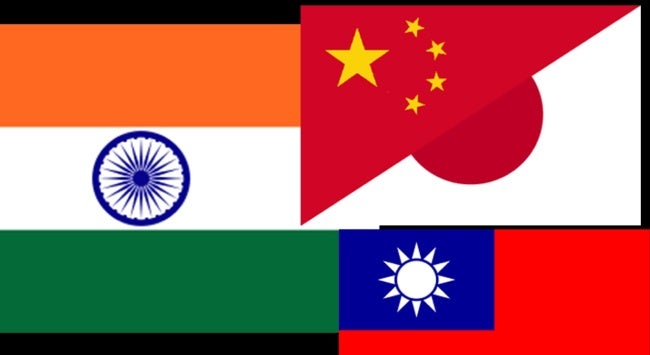
Summary
The recent China-Japan spat over Taiwan has placed India in a delicate position, exposing ambiguity in New Delhi’s approach. India remains unsure about how firmly it should articulate its stance on Taiwan, how far it is prepared to align with Japan against China and where it fits within the United States’ evolving China strategy. Much of this uncertainty reflects India’s longstanding commitment to strategic autonomy, compounded by the wider unpredictability.
Recent weeks have witnessed a growing crisis in China-Japan relations over Taiwan. The crisis started on 7 November 2025 when Japanese Prime Minister Sanae Takaichi, seen as a nationalist hawk, stated that an attack on Taiwan could represent “a situation threatening Japan’s survival”, a legal term that would enable Tokyo to intervene militarily in a conflict involving Taiwan. The comments, which the Japanese prime minister refused to retract, provoked a fierce reaction from Beijing which included bans on Japanese seafood, prompts for Chinese tourists and students to not visit Japan and blocks on the screening of Japanese movies in China. The crisis soon produced military tensions, with a Chinese live-fire exercise in the Yellow Sea, patrolling of Beijing’s coast guard around the disputed Senkaku/Diaoyu islands and Tokyo’s deployment of missiles on the Japanese island of Yonaguni, near Taiwan.
This China-Japan spat does not involve India and has not elicited any reaction from the Indian government. It also did not feature prominently during the brief bilateral meeting between Indian Prime Minister Narendra Modi and Takaichi on the sidelines of the recent G20 summit in Johannesburg. Nevertheless, the China-Japan crisis is important for India as it puts New Delhi in a sensitive position because it reflects the country’s uncertainty on key questions confronting its foreign policy in an Indo-Pacific. There are three key questions raised by the China-Japan spat to which New Delhi has no answer.
First, what is India’s policy on the ‘Taiwan issue’? This question involves both India’s position on the increasingly sensitive politics of Taiwan’s international status and New Delhi’s potential response to a military crisis in the Taiwan Strait. Escalating tensions in the Taiwan Strait and intense United States (US)-China competition in recent years have prompted countries to choose sides – either embracing or opposing the expansion of Taiwan’s international space. New Delhi has enhanced its cooperation with Taipei in recent years but has been careful to not provoke Beijing and cross any red lines. It has also been ambiguous about its official position on the status of Taiwan, highlighted by the controversy surrounding New Delhi’s alleged acceptance of Taiwan as part of China during high-level meetings in August 2025. On the question of a militarised crisis in the Taiwan Strait, India’s position and potential response are unclear. While New Delhi is highly unlikely to intervene in an armed Taiwan conflict despite the economic and strategic stakes involved, it might be dragged into it. In a Taiwan emergency, the US might ask India for access, logistical assistance or the use of the Nicobar and Andaman Islands, making New Delhi choose between a rift with Washington and potential involvement in a war with China. For its part, Beijing might try to influence India’s behaviour in a Taiwan crisis with threats or coercive military actions across the disputed China-India border.
Second, how much is India willing to side with Japan against China? For India, this is a difficult balancing act. On one hand, the relationship between New Delhi and Tokyo has greatly expanded in recent years, turning Japan into one of India’s most important economic, technological and strategic partners. Amid the unpredictability of the Donald Trump administration in the US and the current crisis in US-India relations, Japan’s importance to India is even greater, both bilaterally and within the Quadrilateral Security Dialogue.
On the other hand, Japan is not a full Indian ally, and New Delhi likely wants to stay clear of Tokyo’s quarrels with Beijing over the Senkaku/Diaoyu islands and Taiwan – quarrels that can explode into an armed conflict. Just as important, siding with Japan over Taiwan – one of China’s core interests – is likely to derail relations between Beijing and New Delhi, thawed with great effort after five years of painful freeze. For India, the costs and risks of renewed tensions with China, particularly along their border, will be high. Behind these considerations looms the fundamental questions whether India sees China as an irreconcilable adversary, whose countering makes Japan an Indian ally. Despite its rivalry with Beijing, New Delhi has not made up its mind on this question.
Third, how does India fit into Washington’s China strategy? Relations between India and the US have been partly based on the premise that the former plays a key role in the US’ strategy to counter China – a strategy involving support for Taipei and close collaboration with Tokyo. This premise is increasingly uncertain. While the structural competition between Beijing and Washington persists, the Trump administration has adopted a less hawkish and more transactional approach toward Beijing, with a hesitant attitude toward Taiwan. Trump’s cautious reaction to the China-Japan crisis over Taiwan and push to make Takaichi deescalate the issue, likely at Chinese President Xi Jinping’s request, is indicative of this approach.
Together with recent tensions between the US and India, Trump’s approach to China generates uncertainty about New Delhi’s place in Washington’s China strategy and weakens India’s power position vis-à-vis Beijing. Inevitably, this confuses Indian foreign policy toward Beijing and Washington and destabilises the US-China-India triangle. Moreover, Trump’s policies and reaction to the current China-Japan spat complicate India’s relations with Japan and Taiwan, which have been partly based on the growing US-India partnership. India would find it much more difficult to risk a confrontation with Beijing by siding with Tokyo or upgrading relations with Taipei without reliable American support.
The China–Japan dispute highlights difficult foreign-policy choices for India, which typically relies on strategic autonomy and careful hedging amid rising global uncertainty, especially under the Trump administration. While India can currently manage this ambiguity, a crisis in the Taiwan Strait would likely to force New Delhi to take clearer positions it has so far avoided.
. . . . .
Dr Ivan Lidarev is a Visiting Research Fellow at the Institute of South Asian Studies (ISAS), an autonomous research institute at the National University of Singapore (NUS). He can be contacted at ivanlidarev@nus.edu.sg. The author bears full responsibility for the facts cited and opinions expressed in this paper.
Pic Credit: Wikimedia Commons and ISAS-NUS
-
 More From :
-
 Tags :
-
 Download PDF